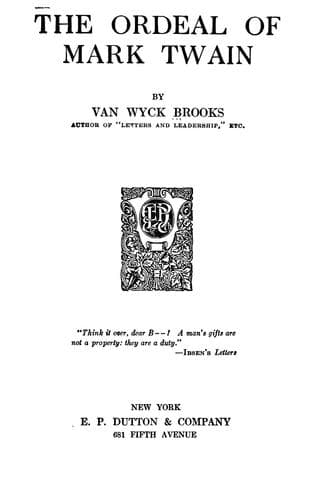
Authors, American -- 19th century -- Biography; Twain, Mark, 1835-1910
Now, we have already seen that this process of "rising in the world," of
succeeding in business, is attained only at the cost of an all but
complete suppression of individuality. The social effect of the
stimulation of the acquisitive instinct in the individual is a general
"levelling down," and this is universally conceded to have been
characteristic of the epoch of industrial pioneering. The whole nation
was practically organized--by a sort of common consent--on the plan of
a vast business establishment, under a majority rule inalterably opposed
to all the inequalities of differentiation and to a moral and æsthetic
development in the individual that would have retarded or compromised
the success of the business régime. We can see, therefore, that if Mark
Twain's humor was universally popular, it was because it, contributed to
the efficiency of this business régime, because it helped to maintain
the psychic equilibrium of the businessman the country over precisely as
it had at first helped to maintain the psychic equilibrium of the
Western pioneer.
As a matter of fact, Mark Twain has often been called the "business
man's writer." In that humor of his, as in no other literature, the
"strong, silent man" who is the archtype of the business world, sees an
aid rather than a menace to his practical efficiency. But why does he
find it an aid and not a menace? Let us put the question the other way
and ask why, in other forms of literature, he finds a menace and not an
aid? The acquisitive and the creative instincts are, as we know,
diametrically opposed, and, as we also know, all manifestations of the
creative spirit demand, require, an emotional effort, a psychic
coöperation, on the part of the reader or the spectator. This accounts
for the business man's proverbial hatred of the artist, a hatred that
expresses itself in a contemptuous desire to "shove him off the map."
Every sort of spiritual expansion, intellectual interest, emotional
freedom implies a retardation of the business man's mental machinery, a
retardation of the "strenuous life," the life of pure action:
consequently, the business man shuns everything that distracts him,
confuses him, stimulates him to think or to feel. Bad for business! On
the other hand, he welcomes everything that simplifies his course,
everything that helps him to cut short his impulses of admiration,
reverence, sympathy, everything that prevents his mind from opening and
responding to the complications and the implications of the spiritual
and intellectual life. And this is precisely what Mark Twain's humor
does. It is just as "irreverent" as the Boston Brahmins thought--and
especially irreverent toward them!--when they gave him a seat below the
salt: it degrades, "takes down," punctures, ridicules as pretentious and
absurd everything of a spiritual, æsthetic and intellectual nature the
recognition of which, the participation in which, would retard the
Public-domain text, read in full here on John Shaqi.
Reviews
Reviews
No reviews yet
Be the first to share your thoughts on this work.
Elsewhere in the archive
Join the Discussion
Join the discussion
Sign in to leave a comment or review.
Sign InorCreate an account