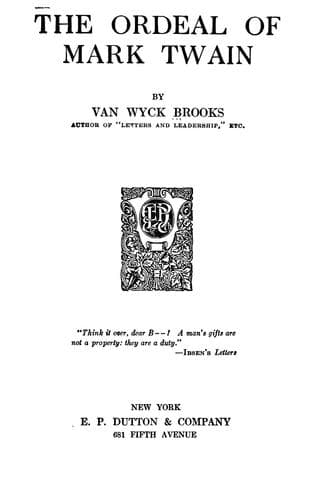
Authors, American -- 19th century -- Biography; Twain, Mark, 1835-1910
To degrade beauty, to debase distinction and thus to simplify the life
of the man with an eye single to the main chance--that, one would almost
say, is the general tendency of Mark Twain's humor. In almost every one
of his sallies, as any one can see who examines them, he burns the house
down in order to roast his pig--he destroys, that is to say, an entire
complex of legitimate pretensions for the sake of puncturing a single
sham. And, as a rule, even the "shams" are not shams at all; they are
manifestations of just that personal, æsthetic or moral distinction
which any but a bourgeois democracy would seek in every way to cherish.
Consider, for example, the value assailed in his famous speech on
General Grant and his big toe. The effect of Mark Twain's humorous
assault on the dignity of General Grant was to reduce him not to the
human but to the common level, to puncture the reluctant reverence of
the groundlings for the fact of moral elevation itself; and the success
of that audacious venture, its success even with General Grant, was the
final proof of the universal acquiescence of a race of pioneers in a
democratic régime opposed, in the name of business, to the recognition
of any superior value in the individual: what made it possible was the
fact that Grant himself had gone the way of all flesh and become a
business man. The supreme example of Mark Twain's humor in this kind is,
however, the "Connecticut Yankee." "It was another of my surreptitious
schemes for extinguishing knighthood by making it grotesque and absurd,"
says the Yankee. "Sir Ozana's saddle was hung about with leather
hat-boxes, and every time he overcame a wandering knight he swore him
into my service and fitted him with a plug and made him wear it." Mark
Twain's contemporaries, Mr. Howells among them, liked to imagine that
in this fashion he was exposing shams and pretensions; but unhappily for
this argument knighthood had been long extinct when Mark Twain undertook
his doughty attack upon it, and it had no unworthy modern equivalent. To
exalt the plug above the plume was a very easy conquest for our
humorist; it was for this reason, and not, as Mark Twain imagined, from
any snobbish self-sufficiency, that the English public failed to be
abashed by the book. In this respect, at least, the "Connecticut Yankee"
was an assault, not upon a social institution, but upon the principle of
beauty itself, an assault, moreover, in the very name of the shrewd
pioneer business man.
Public-domain text, read in full here on John Shaqi.
Reviews
Reviews
No reviews yet
Be the first to share your thoughts on this work.
Elsewhere in the archive
Join the Discussion
Join the discussion
Sign in to leave a comment or review.
Sign InorCreate an account