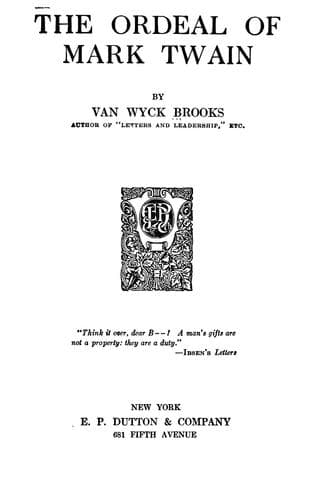
Authors, American -- 19th century -- Biography; Twain, Mark, 1835-1910
the destinies of America; it was evil, and it was mainly evil, in so far
as it contributed to a national self-complacency, to the prevailing
satisfaction of Americans with a banker's paradise in which, as long as
it lasts, the true destinies of America will remain unfulfilled.
So much for the nature and the significance of Mark Twain's humor. I
think we can understand now the prodigious practical success it brought
him. And are we not already in a position to see why the rôle of
humorist was foreign to his nature, why he was reluctant to adopt it,
why he always rebelled against it, and why it arrested his own
development?
Obviously, in Mark Twain, the making of the humorist was the undoing of
the artist. It meant the suppression of his æsthetic desires, the
degradation of everything upon which the creative instinct feeds. How
can a man everlastingly check his natural impulses without in the end
becoming the victim of his own habit?
I have spoken of the "Connecticut Yankee." We know how Mark Twain loved
the tales of Sir Thomas Malory: they were to him a lifelong passion and
delight. As for "knightly trappings," he adored them: think of his love
for gorgeous costumes, of the pleasure he found in dressing up for
charades, of the affection with which he wrote "The Prince and the
Pauper"! When, therefore, in his valiant endeavor to "extinguish
knighthood," he sends Sir Ozana about the country laying violent hands
on wandering knights and clapping plug-hats on their heads he is doing
something very agreeable, indeed, to the complacent American business
man, agreeable to the business man in himself, but in absolute violation
of his own spirit. That is why his taste remained infantile, why he
continued to adore "knightly trappings" instead of developing to a more
advanced æsthetic stage. His feelings for Malory, we are told, was one
of "reverence": the reverence which he felt was the complement of the
irreverence with which he acted. One cannot degrade the undegradeable:
one can actually degrade only oneself, and the result of perpetually
"taking things down" is that one remains "down" oneself, and beauty
becomes more and more inaccessibly "up." That is why, in the presence of
art, Mark Twain always felt, as he said, "like a barkeeper in heaven."
In destroying what he was constrained to consider the false pretensions
of others, he destroyed also the legitimate pretensions of his own soul.
Thus his humor, which had originally served him as a protective
coloration against the consequences of the creative life, ended by
stunting and thwarting that creative life and leaving Mark Twain himself
a scarred child.
Public-domain text, read in full here on John Shaqi.
Reviews
Reviews
No reviews yet
Be the first to share your thoughts on this work.
Elsewhere in the archive
Join the Discussion
Join the discussion
Sign in to leave a comment or review.
Sign InorCreate an account