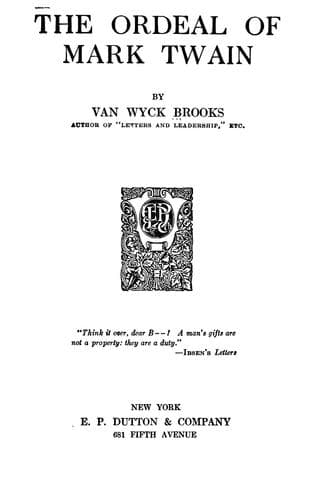
Authors, American -- 19th century -- Biography; Twain, Mark, 1835-1910
"I am persuaded that the future historian of America will find your
works as indispensable to him as a French historian finds the political
tracts of Voltaire." In these words, which he addressed to Mark Twain
himself, Bernard Shaw suggested what was undoubtedly the dominant
intention of Mark Twain's genius, the rôle which he was, if one may say
so, pledged by nature to fulfill. "He will be remembered," says Mr.
Howells, "with the great humorists of all time, with Cervantes, with
Swift, or with any others worthy of his company." Voltaire, Cervantes,
Swift! It was as a satirist, we perceive, as a spiritual emancipator,
that those of his contemporaries who most generously realized him
thought of Mark Twain. Did they not, under the spell of that
extraordinary personal presence of his, in the magnetism, the radiance
of what might be called his temperamental will-to-satire, mistake the
wish for the deed?
What is a satirist? A satirist, if I am not mistaken, is one who holds
up to the measure of some more or less permanently admirable ideal the
inadequacies and the deformities of the society in which he lives. It is
Rabelais holding up to the measure of healthy-mindedness the
obscurantism of the Middle Ages; it is Molière holding up to the measure
on an excellent sociality everything that is eccentric, inelastic,
intemperate; it is Voltaire holding up to the measure of the
intelligence the forces of darkness and superstition: it is a criticism
of the spirit of one's age, and of the facts in so far as the spirit is
embodied in them, dictated by some powerful, personal and supremely
conscious reaction against that spirit. If this is true, Mark Twain
cannot be called a satirist. Certain of the facts of American life he
did undoubtedly satirize. "The state of American society and government
his stories and articles present," says Miss Edith Wyatt, "is, broadly
speaking, truthfully characteristic of the state of society and
government we find now in Chicago, the most murderous and lawless civil
community in the world. What is exceptional in our great humorist's view
of our national life is not the ruffianism of the existence he describes
for us on the Mississippi and elsewhere in the United States, but the
fact that he writes the truth about it." Who will deny that this is so?
Mark Twain satirizes the facts, or some of the facts, of our social
life, he satirizes them vehemently. But when it comes to the spirit of
our social life, that is quite another matter. Let us take his own
humorous testimony: "The silent, colossal National Lie that is the
support and confederate of all the tyrannies and shams and inequalities
and unfairnesses that afflict the peoples--that is the one to throw
bricks and sermons at. But let us be judicious and let somebody else
begin."
Public-domain text, read in full here on John Shaqi.
Reviews
Reviews
No reviews yet
Be the first to share your thoughts on this work.
Elsewhere in the archive
Join the Discussion
Join the discussion
Sign in to leave a comment or review.
Sign InorCreate an account