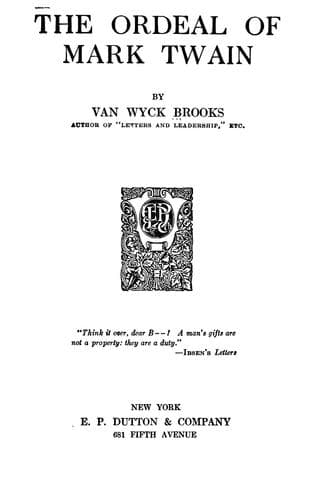
Authors, American -- 19th century -- Biography; Twain, Mark, 1835-1910
Now here, I say, is the crucial instance of Mark Twain's failure as a
satirist. In the moment of crisis the individual in him loses itself in
the herd; the intellect is submerged in a blind emotion that leads him,
unconsciously, into a sort of _bouleversement_ of all his actual
personal intentions. Against his instinct, against his purpose he finds
himself doing, not the thing he really desires to do, i.e., to pry up
the American nation, if the phrase must be used, "to a little higher
level of manhood," which is the true office of an American satirist, but
to flatter the American nation and lull its conscience to sleep. In
short, instead of doing the unpopular thing, which he really wanted to
do, he does the most popular thing of all: he glorifies the Yankee
mechanic, already, in his own country, surfeited with glory, and pours
ridicule upon the two things that least needed ridicule for the good of
the Yankee mechanic's soul, if only because in his eyes they were
sufficiently ridiculous already--England and the Middle Ages.
Could we have a better illustration of the betrayal of Mark Twain's
genius? If any country ever needed satire it is, and was, America. Did
not Mark Twain feel this himself in those rare moments of his middle
years when he saw things truly with his own eyes? Let us take from his
letters a comment on American society that proves it: "There was
absolutely nothing in the morning papers," he writes in 1873: "you can
see for yourself what the telegraphic headings were: BY TELEGRAPH--A
Father Killed by His Son, A Bloody Fight in Kentucky, An Eight-Year-Old
Murderer, A Town in a State of General Riot, A Court House Fired and
Three Negroes Therein Shot While Escaping, A Louisiana Massacre, Two to
Three Hundred Men Roasted Alive, A Lively Skirmish in Indiana (and
thirty other similar headings). The items under those headings all bear
date yesterday, April 16 (refer to your own paper)--and I give you my
word of honor that that string of commonplace stuff was everything there
was in the telegraphic columns that a body could call news. Well, said I
to myself, this is getting pretty dull; this is getting pretty dry;
there don't appear to be anything going on anywhere; has this
progressive nation gone to sleep?" Knowing as we do the significance of
Mark Twain's humor, we divine from the tone of these final comments that
he already considers it none of his business, that as a writer he
proposes to do nothing about it. But his eye is exceedingly wide open to
those things! Would not any one say, therefore, that there is something
rather singular in the spectacle of a human being living alertly in a
land where such incidents were the staple of news and yet being
possessed with an exclusive public passion to "pry the English nation up
to a little higher level of manhood"? Isn't it strange to see the
inhabitant of a country where negroes were being lynched at an average
rate of one every four days filled with "a holy fire of righteous
Public-domain text, read in full here on John Shaqi.
Reviews
Reviews
No reviews yet
Be the first to share your thoughts on this work.
Elsewhere in the archive
Join the Discussion
Join the discussion
Sign in to leave a comment or review.
Sign InorCreate an account