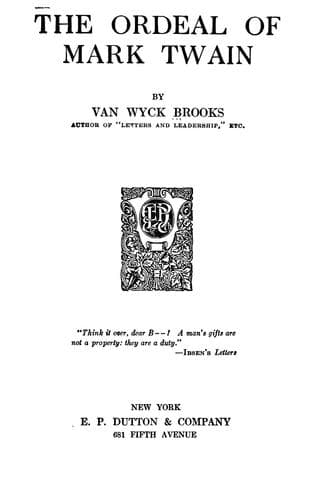
Authors, American -- 19th century -- Biography; Twain, Mark, 1835-1910
respect because of the magnanimity of the motive back of them, but I
think that the ink was wasted. Custom is custom; it is built of brass,
boiler-iron, granite; facts, reasonings, arguments have no more effect
upon it than the idle winds have upon Gibraltar." What would Emerson or
Thoreau have said, fifty years before, of such an argument, such an
assertion of the futility of the individual reason in the face of
"brass, boiler-iron, granite" and mob-emotion? It is perhaps the most
pitifully abject confession ever written by a famous writer.
This is what became of the great American satirist, the Voltaire, the
Swift, the Rabelais of the Gilded Age. If the real prophet is he who
attacks the stultifying illusions of mankind, nothing, on the other
hand, makes one so popular as to be the moral denouncer of what
everybody else denounces. Of the real and difficult evils of society
Mark Twain, to be sure, knew little. He attacked monarchy, yes; but
monarchy was already an obsolescent evil, and in any case this man who
took such delight in "walking with kings," as the advertisements say, in
actual life, never attacked the one monarch who really was, as it
appeared, secure in his seat, the Kaiser. He attacked monarchy because,
as he said, it was an eternal denial of "the numerical mass of the
nation," He had become, in fact, the incarnation of that numerical mass,
the majority, which, in the face of all his personal impulses, he could
not consider as anything but invariably right. He could not be the
spokesman of the immensities and the eternities, as Carlyle had been,
for he knew them not; he could not be, like Anatole France, the
spokesman of justice, for indeed he had no ideal. His only criterion was
personal, and that was determined by his friends. "On the whole," as Mr.
Paine says, "Clemens wrote his strictures more for relief than to
print," and when he printed them it was because he had public opinion
behind him. Revolt as he might, and he never ceased to revolt, he was
the same man who, at the psychological moment, in "The Innocents
Abroad," by disparaging Europe and its art and its glamorous past, by
disparaging, in short, the history of the human spirit, had flattered
the expanding impulse of industrial America. In the face of his own
genius, in the face of his own essential desire, he had pampered for a
whole generation that national self-complacency which Matthew Arnold
quite accurately described as vulgar, and not only vulgar but retarding.
Public-domain text, read in full here on John Shaqi.
Reviews
Reviews
No reviews yet
Be the first to share your thoughts on this work.
Elsewhere in the archive
Join the Discussion
Join the discussion
Sign in to leave a comment or review.
Sign InorCreate an account