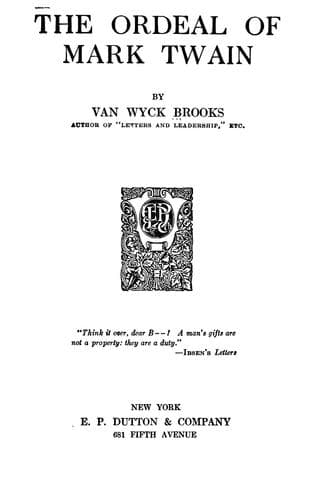
Authors, American -- 19th century -- Biography; Twain, Mark, 1835-1910
Yes, the tragic thing about an environment as coercive as ours is that
we are obliged to endow it with the majesty of destiny itself in order
to save our own faces! We dwell on the conditions that hamper us,
destroy us, we embrace them with an _amor fati_, to escape from the
contemplation of our own destruction. "Outside influences, outside
circumstances, wind the man and regulate him. Left to himself, he
wouldn't get regulated at all, and the sort of time he would keep would
not be valuable." There is the complete philosophy of the moral slave
who not only has no autonomy but wishes to have none, who, in fact,
finds all his comfort in having none, and delights in denying the
possibility of independence just because he does not possess it himself.
The pragmatists have escaped this net in their own interestingly
temperamental fashion, like flying-fish, by jumping over it. It remains,
nevertheless, the characteristic philosophy of Americans who have a deep
emotional stake in the human situation; and one might almost say that it
honors Mark Twain. We only perceive, we are only mortified by the
slavery of men, when nature has endowed us with the true hunger and
thirst for freedom.
Who can doubt, indeed, that it was the very greatness of his potential
force, the strength of his instinctive preferences, that confirmed in
Mark Twain his inborn Calvinistic will-to-despise human nature, that
fixed in him the obsession of the miscarriage of the human spirit? If
the great artist is the freest man, if the true creative life is, in
fact, the embodiment of "free will," then it is only he that is born for
greatness who can feel, as Mark Twain felt, that the universe is leagued
against him. The common man has no sense of having surrendered his will:
he regards it as a mere pretension of the philosophers that man has a
will to surrender. He eats, drinks and continues to be merry or morose
regardless of his moral destiny: to possess no principle of growth, no
spiritual backbone is, indeed, his greatest advantage in a world where
success is the reward of accommodation. It is nothing to him that man is
a "chameleon" who "by the law of his nature takes the color of his place
of resort"; it is nothing to him whether or not, as Mark Twain said, the
first command the Deity issued to a human being on this planet was "Be
weak, be water, be characterless, be cheaply persuadable," knowing that
Adam would never be able to disobey. It is nothing to him, or rather it
is much: for it is by this means that he wins his worldly prestige. How
well, for that matter, it served the prevailing self in Mark Twain!
"From the cradle to the grave, during all his waking hours, the human
being is under training. It is his human environment which influences
his mind and his feelings, furnishes him his ideals, and sets him on his
road and keeps him in it. If he leave that road he will find himself
shunned by the people whom he most loves and esteems, and whose approval
he most values....
Public-domain text, read in full here on John Shaqi.
Reviews
Reviews
No reviews yet
Be the first to share your thoughts on this work.
Elsewhere in the archive
Join the Discussion
Join the discussion
Sign in to leave a comment or review.
Sign InorCreate an account