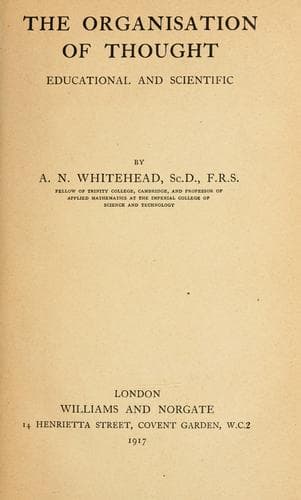
The organisation of thought, educational and scientificWhitehead, Alfred North
Philosophy
The organisation of thought, educational and scientific
Whitehead, Alfred North
Education
Our courses of instruction should be planned to illustrate simply a
succession of ideas of obvious importance. All pretty divagations
should be rigorously excluded. The goal to be aimed at is that the
pupil should acquire familiarity with abstract thought, should realise
how it applies to particular concrete circumstances, and should know
how to apply general methods to its logical investigation. With this
educational ideal nothing can be worse than the aimless accretion
of theorems in our text-books, which acquire their position merely
because the children can be made to learn them and examiners can set
neat questions on them. The bookwork to be learnt should all be very
important as illustrating ideas. The examples set--and let there
be as many examples as teachers find necessary--should be direct
illustrations of the theorems, either by way of abstract particular
cases or by way of application to concrete phenomena. Here it is worth
remarking that it is quite useless to simplify the bookwork, if the
examples set in examinations in fact require an extended knowledge of
recondite details. There is a mistaken idea that problems test ability
and genius, and that bookwork tests cram. This is not my experience.
Only boys who have been specially crammed for scholarships can ever
do a problem paper successfully. Bookwork properly set, not in mere
snippets according to the usual bad plan, is a far better test of
ability, provided that it is supplemented by direct examples. But this
is a digression on the bad influence of examinations on teaching.
The main ideas which lie at the base of mathematics are not at all
recondite. They are abstract. But one of the main objects of the
inclusion of mathematics in a liberal education is to train the pupils
to handle abstract ideas. The science constitutes the first large
group of abstract ideas which naturally occur to the mind in any
precise form. For the purposes of education, mathematics consists of
the relations of number, the relations of quantity, and the relations
of space. This is not a general definition of mathematics, which, in
my opinion, is a much more general science. But we are now discussing
the use of mathematics in education. These three groups of relations,
concerning number, quantity, and space, are interconnected.
Public-domain text, read in full here on John Shaqi.
Reviews
Reviews
No reviews yet
Be the first to share your thoughts on this work.
Join the Discussion
Join the discussion
Sign in to leave a comment or review.
Sign InorCreate an account