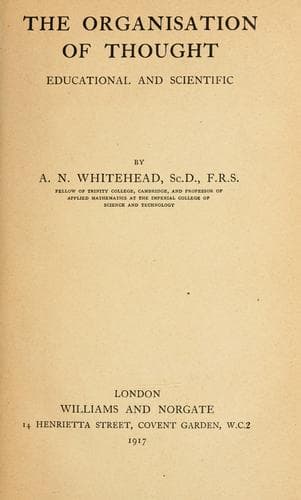
The organisation of thought, educational and scientificWhitehead, Alfred North
Philosophy
The organisation of thought, educational and scientific
Whitehead, Alfred North
Education
Now, in education we proceed from the particular to the general.
Accordingly, children should be taught the use of these ideas by
practice among simple examples. My point is this: The goal should be,
not an aimless accumulation of special mathematical theorems, but the
final recognition that the preceding years of work have illustrated
those relations of number, and of quantity, and of space, which are of
fundamental importance. Such a training should lie at the base of all
philosophical thought. In fact elementary mathematics rightly conceived
would give just that philosophical discipline of which the ordinary
mind is capable. But what at all costs we ought to avoid, is the
pointless accumulation of details. As many examples as you like; let
the children work at them for terms, or for years. But these examples
should be direct illustrations of the main ideas. In this way, and
this only, can the fatal reconditeness be avoided.
I am not now speaking in particular of those who are to be professional
mathematicians, or of those who for professional reasons require a
knowledge of certain mathematical details. We are considering the
liberal education of all students, including these two classes. This
general use of mathematics should be the simple study of a few general
truths, well illustrated by practical examples. This study should
be conceived by itself, and completely separated in idea from the
professional study mentioned above, for which it would make a most
excellent preparation. Its final stage should be the recognition of
the general truths which the work done has illustrated. As far as I
can make out, at present the final stage is the proof of some property
of circles connected with triangles. Such properties are immensely
interesting to mathematicians. But are they not rather recondite,
and what is the precise relation of such theorems to the ideal of
a liberal education? The end of all the grammatical studies of the
student in classics is to read Virgil and Horace--the greatest thoughts
of the greatest men. Are we content, when pleading for the adequate
representation in education of our own science, to say that the end of
a mathematical training is that the student should know the properties
of the nine-point circle? I ask you frankly, is it not rather a "come
down"?
This generation of mathematical teachers has done so much strenuous
work in the way of reorganising mathematical instruction that there is
no need to despair of its being able to elaborate a curriculum which
shall leave in the minds of the pupils something even nobler than "the
ambiguous case."
Public-domain text, read in full here on John Shaqi.
Reviews
Reviews
No reviews yet
Be the first to share your thoughts on this work.
Join the Discussion
Join the discussion
Sign in to leave a comment or review.
Sign InorCreate an account