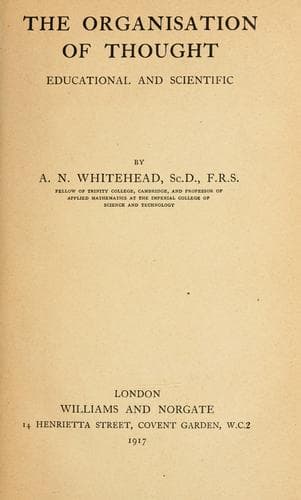
The organisation of thought, educational and scientificWhitehead, Alfred North
Philosophy
The organisation of thought, educational and scientific
Whitehead, Alfred North
Education
Another way in which the students' ideas can be generalised is by the
use of the History of Mathematics, conceived not as a mere assemblage
of the dates and names of men, but as an exposition of the general
current of thought which occasioned the subjects to be objects of
interest at the time of their first elaboration. The use of the History
of Mathematics is to be considered at a later stage of our proceedings
this afternoon. Accordingly I merely draw attention to it now, to
point out that perhaps it is the very subject which may best obtain the
results for which I am pleading.
We have indicated two main topics, namely general ideas of quantity
and of laws of nature, which should be an object of study in the
mathematical curriculum of a liberal education. But there is another
side to mathematics which must not be overlooked. It is the chief
instrument for discipline in logical method.
Now, what is logical method, and how can any one be trained in it?
Logical method is more than the mere knowledge of valid types of
reasoning and practice in the concentration of mind necessary to
follow them. If it were only this, it would still be very important;
for the human mind was not evolved in the bygone ages for the sake of
reasoning, but merely to enable mankind with more art to hunt between
meals for fresh food supplies. Accordingly few people can follow close
reasoning without considerable practice.
More than this is wanted to make a good reasoner, or even to enlighten
ordinary people with knowledge of what constitutes the essence of the
art. The art of reasoning consists in getting hold of the subject at
the right end, of seizing on the few general ideas which illuminate
the whole, and of persistently marshalling all subsidiary facts round
them. Nobody can be a good reasoner unless by constant practice he
has realised the importance of getting hold of the big ideas and of
hanging on to them like grim death. For this sort of training geometry
is, I think, better than algebra. The field of thought of algebra is
rather obscure, whereas space is an obvious insistent thing evident to
all. Then the process of simplification, or abstraction, by which all
irrelevant properties of matter, such as colour, taste, and weight, are
put aside is an education in itself. Again, the definitions and the
propositions assumed without proof illustrate the necessity of forming
clear notions of the fundamental facts of the subject-matter and of the
relations between them. All this belongs to the mere prolegomena of the
subject. When we come to its development, its excellence increases. The
learner is not initially confronted with any symbolism which bothers
the memory by its rules, however simple they may be. Also, from the
very beginning the reasoning, if properly conducted, is dominated by
well-marked ideas which guide each stage of development. Accordingly
the essence of logical method receives immediate exemplification.
Public-domain text, read in full here on John Shaqi.
Reviews
Reviews
No reviews yet
Be the first to share your thoughts on this work.
Join the Discussion
Join the discussion
Sign in to leave a comment or review.
Sign InorCreate an account