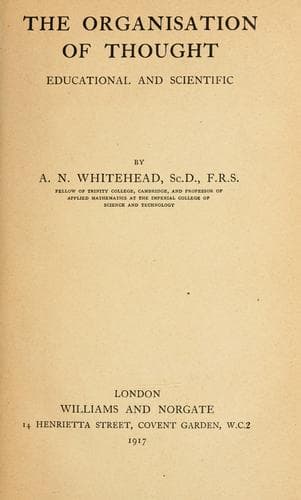
The organisation of thought, educational and scientificWhitehead, Alfred North
Philosophy
The organisation of thought, educational and scientific
Whitehead, Alfred North
Education
fit for backward pupils; but certainly it could be made interesting to
the more advanced class. There would be great scope for interesting
discussion as to the nature of quantity, and the tests which we should
apply to ascertain when we are dealing with quantities. The work
would not be at all in the air, but would be illustrated at every
stage by reference to actual examples of cases where the quantitative
character is absent, or obscure, or doubtful, or evident. Temperature,
heat, electricity, pleasure and pain, mass and distance could all be
considered.
Another idea which requires illustration is that of functionality.
A function in analysis is the counterpart of a law in the physical
universe, and of a curve in geometry. Children have studied the
relations of functions to curves from the first beginning of their
study of algebra, namely in drawing graphs. Of recent years there has
been a great reform in respect to graphs. But at its present stage it
has either gone too far or not far enough. It is not enough merely
to draw a graph. The idea behind the graph--like the man behind the
gun--is essential in order to make it effective. At present there is
some tendency merely to set the children to draw curves, and there to
leave the whole question.
In the study of simple algebraic functions and of trigonometrical
functions we are initiating the study of the precise expression of
physical laws. Curves are another way of representing these laws. The
simple fundamental laws--such as the inverse square and the direct
distance--should be passed under review, and the applications of the
simple functions to express important concrete cases of physical laws
considered. I cannot help thinking that the final review of this topic
might well take the form of a study of some of the main ideas of the
differential calculus applied to simple curves. There is nothing
particularly difficult about the conception of a rate of change; and
the differentiation of a few powers of _x_, such as _x_^2,
_x_^3, etc., could easily be effected; perhaps by the aid of
geometry even sin _x_ and cos _x_ could be differentiated.
If we once abandon our fatal habit of cramming the children with
theorems which they do not understand, and will never use, there will
be plenty of time to concentrate their attention on really important
topics. We can give them familiarity with conceptions which really
influence thought.
Before leaving this topic of physical laws and mathematical functions,
there are other points to be noticed. The fact that the precise law is
never really verified by observation in its full precision is capable
of easy illustration and of affording excellent examples. Again,
statistical laws, namely laws which are only satisfied on the average
by large numbers, can easily be studied and illustrated. In fact a
slight study of statistical methods and their application to social
phenomena affords one of the simplest examples of the application of
algebraic ideas.
Public-domain text, read in full here on John Shaqi.
Reviews
Reviews
No reviews yet
Be the first to share your thoughts on this work.
Join the Discussion
Join the discussion
Sign in to leave a comment or review.
Sign InorCreate an account