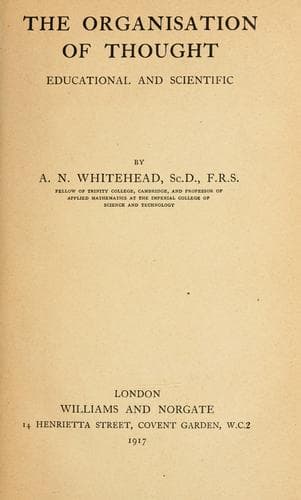
The organisation of thought, educational and scientificWhitehead, Alfred North
Philosophy
The organisation of thought, educational and scientific
Whitehead, Alfred North
Education
The third stage is the study of the elements of trigonometry. This is
the study of the periodicity introduced by rotation and of properties
preserved in a correlation of similar figures. Here for the first time
we introduce a slight use of the algebraic analysis founded on the
study of number and quantity. The importance of the periodic character
of the functions requires full illustration. The simplest properties of
the functions are the only ones required for the solution of triangles,
and the consequent applications to surveying. The wealth of formulæ,
often important in themselves, but entirely useless for this type of
study, which crowd our books should be rigorously excluded, except
so far as they are capable of being proved by the pupils as direct
examples of the bookwork.
This question of the exclusion of formulæ is best illustrated by
considering this example of Trigonometry, though of course I may well
have hit on an unfortunate case in which my judgment is at fault. A
great part of the educational advantage of the subject can be obtained
by confining study to Trigonometry of one angle and by exclusion of the
addition formulæ for the sine and cosine of the sum of two angles. The
functions can be graphed, and the solution of triangles effected. Thus
the aspects of the science as (1) embodying analytically the immediate
results of some of the theorems deduced from congruence and similarity,
(2) as a solution of the main problem of surveying, (3) as a study of
the fundamental functions required to express periodicity and wave
motion, will all be impressed on the pupils' minds both by bookwork and
example.
If it be desired to extend this course, the addition formulæ should
be added. But great care should be taken to exclude specialising
the pupils in the wealth of formulæ which comes in their train. By
"exclude" is meant that the pupils should not have spent time or energy
in acquiring any facility in their deduction. The teacher may find
it interesting to work a few such examples before a class. But such
results are not among those which learners need retain. Also, I would
exclude the whole subject of circumscribed and inscribed circles both
from Trigonometry and from the previous geometrical courses. It is
all very pretty, but I do not understand what its function is in an
elementary non-professional curriculum.
Accordingly, the actual bookwork of the subject is reduced to very
manageable proportions. I was told the other day of an American college
where the students are expected to know by heart ninety formulæ or
results in Trigonometry alone. We are not quite so bad as that. In
fact, in Trigonometry we have nearly approached the ideal here sketched
out as far as our elementary courses are concerned.
Public-domain text, read in full here on John Shaqi.
Reviews
Reviews
No reviews yet
Be the first to share your thoughts on this work.
Elsewhere in the archive
Join the Discussion
Join the discussion
Sign in to leave a comment or review.
Sign InorCreate an account