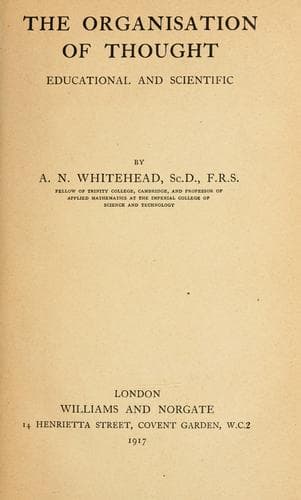
The organisation of thought, educational and scientificWhitehead, Alfred North
Philosophy
The organisation of thought, educational and scientific
Whitehead, Alfred North
Education
The fourth stage introduces Analytical Geometry. The study of graphs in
algebra has already employed the fundamental notions, and all that is
now required is a rigorously pruned course on the straight line, the
circle, and the three types of conic sections, defined by the forms of
their equations. At this point there are two remarks to be made. It is
often desirable to give our pupils mathematical information which we do
not prove. For example, in co-ordinate geometry, the reduction of the
general equation of the second degree is probably beyond the capacities
of most of the type of students whom we are considering. But that need
not prevent us from explaining the fundamental position of conics, as
exhausting the possible types of such curves.
The second remark is to advocate the entire sweeping away of
geometrical conics as a separate subject. Naturally, on suitable
occasions the analysis of analytical geometry will be lightened by
the use of direct deduction from some simple figure. But geometrical
conics, as developed from the definition of a conic section by the
focus and directrix property, suffers from glaring defects. It is
hopelessly recondite. The fundamental definition of a conic, _SP_ = _e_
· _PM_, usual in this subject at this stage, is thoroughly bad. It is
very recondite, and has no obvious importance. Why should such curves
be studied at all, any more than those defined by an indefinite number
of other formulæ? But when we have commenced the study of the Cartesian
methods, the equations of the first and second degrees are naturally
the first things to think about.
In this ideal course of Geometry, the fifth stage is occupied with
the elements of Projective Geometry. The general ideas of cross ratio
and of projection are here fundamental. Projection is yet a more
general instance of that one-to-one correlation which we have already
considered under congruence and similarity. Here again we must avoid
the danger of being led into a bewildering wealth of detail.
The intellectual idea which projective geometry is to illustrate is
the importance in reasoning of the correlation of all cases which
can be proved to possess in common certain identical properties. The
preservation of the projective properties in projection is the one
important educational idea of the subject. Cross ratio only enters
as the fundamental metrical property which is preserved. The few
propositions considered are selected to illustrate the two allied
processes which are made possible by this procedure. One is proof
by simplification. Here the simplification is psychological and not
logical--for the general case is logically the simplest. What is meant
is: Proof by considering the case which is in fact the most familiar to
us, or the easiest to think about. The other procedure is the deduction
of particular cases from known general truths, as soon as we have a
means of discovering such cases or a criterion for testing them.
Public-domain text, read in full here on John Shaqi.
Reviews
Reviews
No reviews yet
Be the first to share your thoughts on this work.
Elsewhere in the archive
Join the Discussion
Join the discussion
Sign in to leave a comment or review.
Sign InorCreate an account