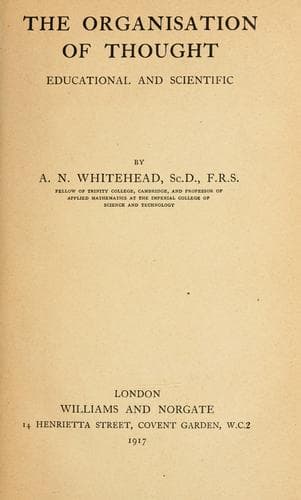
The organisation of thought, educational and scientificWhitehead, Alfred North
Philosophy
The organisation of thought, educational and scientific
Whitehead, Alfred North
Education
I shall call the latter of these two sections the mathematical section,
and the former the non-mathematical section. But I must repeat that by
the mathematical section is meant that large number of boys who desire
to learn more than the minimum amount of mathematics. Furthermore, most
of my remarks about these sections of boys apply also to elementary
classes of our University students.
The subject of this paper is the investigation of the place which
should be occupied by modern investigations respecting mathematical
principles in the education of both of these sections of school-boys.
To find a foothold from which to start the inquiry, let us ask why the
non-mathematical section should be taught any mathematics at all beyond
the barest elements of arithmetic. What are the qualities of mind which
a mathematical training is designed to produce when it is employed as
an element in a liberal education?
My answer, which applies equally to both sections of students, is
that there are two allied forms of mental discipline which should be
acquired by a well-designed mathematical course. These two forms though
closely allied are perfectly distinct.
The first form of discipline is not in its essence logical at all.
It is the power of clearly grasping abstract ideas, and of relating
them to particular circumstances. In other words, the first use of
mathematics is to strengthen the power of abstract thought. I repeat
that in its essence this has nothing to do with logic, though as a
matter of fact a logical discipline is the best method of producing the
desired effect. It is not the philosophical theory of abstract ideas
which is to be acquired, but the habit and the power of using them.
There is one and only way of acquiring the habit and the power of using
anything, that is by the simple common-place method of habitually using
it. There is no other short cut. If in education we desire to produce
a certain conformation of mind, we must day by day, and year by year,
accustom the students' minds to grow into the desired structural shape.
Thus to teach the power of grasping abstract ideas and the habit of
using them, we must select a group of such ideas, which are important
and are also easy to think about because they are clear and definite.
The fundamental mathematical truths concerning geometry, ratio,
quantity, and number, satisfy these conditions as do no others. Hence,
the fundamental universal position held by mathematics as an element of
a liberal education.
But what are the fundamental mathematical truths concerning geometry,
quantity and number?
At this point we come to the great question of the relation between
the modern science of the principles of mathematics and a mathematical
education.
Public-domain text, read in full here on John Shaqi.
Reviews
Reviews
No reviews yet
Be the first to share your thoughts on this work.
Elsewhere in the archive
Join the Discussion
Join the discussion
Sign in to leave a comment or review.
Sign InorCreate an account