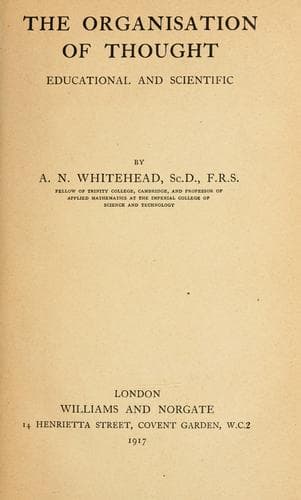
The organisation of thought, educational and scientificWhitehead, Alfred North
Philosophy
The organisation of thought, educational and scientific
Whitehead, Alfred North
Education
My answer to the question as to these fundamental mathematical truths
is, that in any absolute sense there are none. There is no unique
small body of independent primitive unproved propositions which are
the necessary starting points of all mathematical reasoning on these
subjects. In mathematical reasoning the only absolute necessary
pre-suppositions are those which make logical deduction possible.
Between these absolute logical truths and so-called fundamental truths
concerning geometry, quantity and number, there is a whole new world of
mathematical subjects concerning the logic of propositions, of classes,
and of relations.
But this subject is too abstract to form an elementary training ground
in the difficult art of abstract thought.
It is for this reason that we have to make a compromise and start from
such obvious general ideas as naturally occur to all men when they
perceive objects with their senses.
In geometry, the ideas elaborated by the Greeks and presented by Euclid
are, roughly speaking, those adapted for our purpose, namely, ideas
of volumes, surfaces, lines, of straightness and of curvature, of
intersection and of congruence, of greater and less, of similarity,
shape, and scale. In fact, we use in education those general ideas of
spatial properties which must be habitually present in the mind of any
one who is to observe the world of phenomena with understanding.
Thus we come back to Plato's opinion that for a liberal education,
geometry, as he knew it, is the queen of sciences.
In addition to geometry, there remain the ideas of quantity, ratio,
and of number. This in practice means, elementary algebra. Here the
prominent ideas are those of "any number," in other words, the use
of the familiar _x_, _y_, _z_, and of the dependence of variables on
each other, or otherwise, the idea of functionality. All this is to be
gradually acquired by the continual use of the very simplest functions
which we can devise: of linear functions, graphically represented
by straight lines; of quadratic functions, graphically represented
by parabolas; and of those simple implicit functions, graphically
represented by conic sections. Thence, with good fortune and a willing
class, we can advance to the ideas of rates of increase, still
confining ourselves to the simplest possible cases.
I wish here emphatically to remind you that both in geometry and in
algebra a clear grasp of these general ideas is not what the pupil
starts from, it is the goal at which he is to arrive. The method of
progression is continual practice in the consideration of the simplest
particular cases, and the goal is not philosophical analysis but the
power of use.
But how is he to practise himself in their use? He cannot simply sit
down and think of the relation _y_ = _x_ + 1, he must employ
it in some simple obvious way.
Public-domain text, read in full here on John Shaqi.
Reviews
Reviews
No reviews yet
Be the first to share your thoughts on this work.
Elsewhere in the archive
Join the Discussion
Join the discussion
Sign in to leave a comment or review.
Sign InorCreate an account