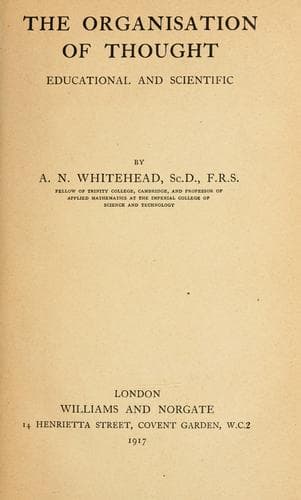
The organisation of thought, educational and scientificWhitehead, Alfred North
Philosophy
The organisation of thought, educational and scientific
Whitehead, Alfred North
Education
It is a more difficult question to determine whether the condition here
indicated as sufficient to secure the punctual type of convergence
is also necessary. The question turns on how far thought-objects
of perception possess exact boundaries prior to the elaboration of
exact mathematical concepts of space. If they are to be conceived as
possessing such exact boundaries, then convergent sets converging to
points on such boundaries must be allowed for. The procedure necessary
for the specification of the complete punctual condition becomes then
very elaborate,[3] and will not be considered here.
But such exact determination as is involved in the conception of
an exact spatial boundary does not seem to belong to the true
thought-object of perception. The ascription of an exact boundary
really belongs to the transition stage of thought as it passes from
the thought-object of perception to the thought-object of science.
The transition from the sense-object immediately presented to the
thought-object of perception is historically made in a wavering
indeterminate line of thought. The definite stages here marked out
simply serve to prove that a logically explicable transition is
possible.
We accordingly assume that the condition laid down above to secure the
punctual convergence of a convergent set of enclosure-objects is not
only sufficient, but necessary.
It can be proved that, if two convergent sets of enclosure-objects are
both equal to a third convergent set, they are equal to each other.
Consider now any punctual convergent set (α). We want to define the
"point" to which α is a route of approximation in a way which is
neutral between α and all the convergent sets which are equal to α.
Each of these sets is a route of approximation to the same "point"
as α. This definition is secured if we define the point as the class
formed by all the enclosure-objects which belong either to α or to
any convergent set which is equal to α. Let _P_ be this class
of enclosure-objects. Then any convergent set (β) which consists of
enclosure-objects entirely selected from members of the class _P_
must be a route of approximation to the same "point" as does the
original punctual set α; namely, provided that we choose a small enough
enclosure-object in β, we can always find a member of α which encloses
it; and provided that we choose a small enough enclosure-object in
α, we can always find a member of β which encloses it. Thus _P_
only includes convergent sets of the punctual type, and the route
of approximation indicated by any two convergent sets selected from
_P_ converges to identical results.
Public-domain text, read in full here on John Shaqi.
Reviews
Reviews
No reviews yet
Be the first to share your thoughts on this work.
Elsewhere in the archive
Join the Discussion
Join the discussion
Sign in to leave a comment or review.
Sign InorCreate an account