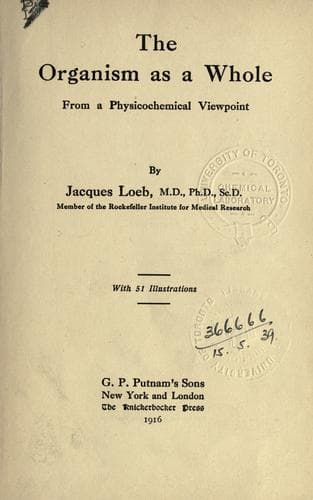
The Organism as a Whole, from a Physicochemical ViewpointLoeb, Jacques
Science
The Organism as a Whole, from a Physicochemical Viewpoint
Loeb, Jacques
Biology; Life (Biology); Mendel's law
6. We have mentioned the ideas concerning a design, or “entelechy,”
acting as a guide to the developing egg and have shown that this
revival of Platonic and Aristotelian philosophy in biology was due to a
misconception; namely, that the egg consisted of homogeneous material
which was to be differentiated into an organism. For this supernatural
task supernatural agencies seemed required. But we have seen that
the unfertilized egg is already differentiated in a way which makes
the further differentiation a natural affair. This idea of a quasi
superhuman intelligence presiding over the forces of the living is met
with in the field of regeneration, and here again it is based upon a
misconception. The lens of the eye is formed in the embryo from the
epithelium lying above the so-called optic cup (the primitive retina).
Where this retina touches the epithelium the latter begins to grow into
the cup, the ingrowing piece of epithelium is cut off and forms the
lens, which probably under the influence of substances secreted by the
optic cup becomes transparent. Certain animals like the salamander are
able to form a new lens when the old one has been removed by operation,
but the new lens is formed in an entirely different way; namely, from
the upper edge of the iris. G. Wolf, who observed this regeneration
used it to endow the organism with a knowledge of its needs; the idea
of a Platonic preconceived plan or an Aristotelian purpose suggested
itself. But it can be shown that the organism does in this case what
it is compelled to do by its physical and chemical structure.
Public-domain text, read in full here on John Shaqi.
Reviews
Reviews
No reviews yet
Be the first to share your thoughts on this work.
Elsewhere in the archive
Join the Discussion
Join the discussion
Sign in to leave a comment or review.
Sign InorCreate an account