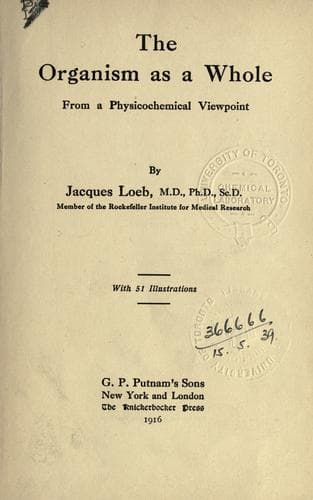
The Organism as a Whole, from a Physicochemical ViewpointLoeb, Jacques
Science
The Organism as a Whole, from a Physicochemical Viewpoint
Loeb, Jacques
Biology; Life (Biology); Mendel's law
4. We are not concerned in this volume with the many applications of
the theory of heredity to the breeding of plants, animals, and man;
the reader will find a discussion of these topics in the numerous
writings of the special workers on genetics.[208] We are, however,
interested in the bearing this work has on the conception of the
organism. Two questions present themselves: Is the organism nothing but
a mosaic of hereditary characters determined essentially by definite
elements located in the chromosomes; and if this be true, what makes
a harmonious whole organism out of this kaleidoscopic assortment?
We call it a kaleidoscopic assortment since a glance at the list of
hereditary characters found in one chromosome, according to Morgan,
shows that there is apparently no physiological or chemical connection
between them, and second: How can a factor contained in the chromosome
determine a hereditary character of the organism? To the first question
we venture to offer the answer which has been already suggested in
various chapters of this book, that the cytoplasm of the egg is the
future embryo in the rough; and that the factors of heredity in the
sperm only act by impressing the details upon the rough block. This
metaphor will receive a more definite meaning by the answer to the
second question. The characters which follow Mendelian heredity are
morphological features as well as instincts. For the former we have
already had occasion to show in previous chapters to what extent they
depend upon the internal secretions or the existence of specific
compounds in the circulation, and the same is true for the instincts
(Chapters VIII and X). This then leads us to the suggestion that
these determiners contained in the chromosomes give rise each to the
formation of one or more specific substances which influence various
parts of the body. We probably do not notice all the effects in each
case, but when a special organ is affected in a conspicuous way, we
connect the factor with this organ or the special feature of the organ
which is altered, and speak of a determiner or factor for that organ,
or for one of its characters. We also understand in this way why
outside conditions should be able to overcome the hereditary tendency
in certain cases, for instance why the influence of certain hereditary
factors for pigmentation should depend upon temperature as E. Baur
observed.
[208] Bateson, W., _Mendel’s Principles of Heredity_, 3d ed., 1913;
Davenport, Chas. B., _Heredity in Relation to Eugenics_, 1911. Pearl,
R., _Modes of Research in Genetics_.
Public-domain text, read in full here on John Shaqi.
Reviews
Reviews
No reviews yet
Be the first to share your thoughts on this work.
Elsewhere in the archive
Join the Discussion
Join the discussion
Sign in to leave a comment or review.
Sign InorCreate an account