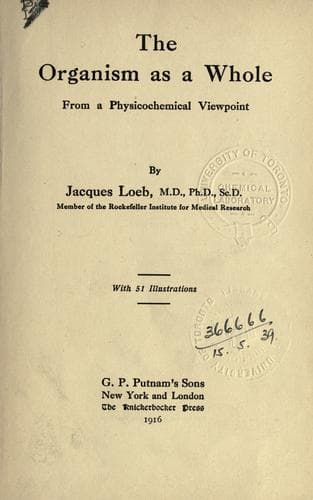
The Organism as a Whole, from a Physicochemical ViewpointLoeb, Jacques
Science
The Organism as a Whole, from a Physicochemical Viewpoint
Loeb, Jacques
Biology; Life (Biology); Mendel's law
This chapter would not be complete without an intimation of the rôle of
buffers in the sea water and the blood, by which the reaction of these
media is prevented from changing in a way injurious to the organism.
These buffers are the carbonates and phosphates. Instead of saying that
the organisms are adapted to the medium, L. Henderson has pointed out
the fitness of the environment for the development of organisms and one
of these elements of fitness are the buffers against alterations of
the hydrogen ion concentration.[274] The ratio in which the salts of
the different metals exist in the sea water is another. It is obvious
that the quantitative laws prevailing in the effect of environment
upon organisms leave no more room for the interference of a “directing
force” of the vitalist than do the laws of the motion of the solar
system.
[274] Henderson, L., _The Fitness of the Environment_. See also
Michaelis, L., _Die Wasserstoffionenconzentration_. Berlin. 1914.
CHAPTER XII
ADAPTATION TO ENVIRONMENT
1. It is assumed by certain biologists that the environment influences
the organism in such a way as to increase its adaptation. Were this
correct it would not contradict a purely physicochemical conception of
life; it would only call for an explanation of the mechanism by which
the adaptation is brought about. There are striking cases on record
which warn us against the universal correctness of the view that the
environment causes an adaptive modification of the organism. Thus
the writer pointed out in 1889 that positive heliotropism occurs in
organisms which have no opportunity to make use of it,[275] _e. g._,
_Cuma rathkii_, a crustacean living in the mud, and the caterpillars
of the willow borer living under the bark of the trees. We understand
today why this should be so, since heliotropism depends upon the
presence of photosensitive substances, and it can readily be seen that
the question of use or disuse has nothing to do with the production of
certain harmless chemical compounds in the body. A much more striking
example is offered in the case of galvanotropism. Many organisms
show the phenomenon of galvanotropism, yet, as the writer pointed
out years ago, galvanotropism is purely a laboratory product and no
animal has ever had a chance or will ever have a chance to be exposed
to a constant current except in the laboratory of a scientist. This
fact is as much of a puzzle to the selectionist and to the Lamarckian
(who would be at a loss to explain how outside conditions could have
developed this tropism) as to the vitalist who would have to admit
that the genes and supergenes indulge occasionally in queer freaks
and lapses. The only consistent attitude is that of the physicist who
assumes that the reactions and structures of animals are consequences
of the chemical and physical forces, which no more serve a purpose than
those forces responsible for the solar systems. From this viewpoint it
Public-domain text, read in full here on John Shaqi.
Reviews
Reviews
No reviews yet
Be the first to share your thoughts on this work.
Elsewhere in the archive
Join the Discussion
Join the discussion
Sign in to leave a comment or review.
Sign InorCreate an account