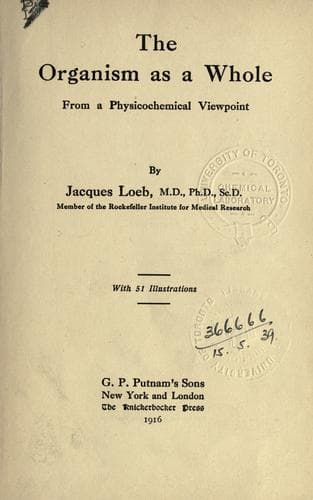
The Organism as a Whole, from a Physicochemical ViewpointLoeb, Jacques
Science
The Organism as a Whole, from a Physicochemical Viewpoint
Loeb, Jacques
Biology; Life (Biology); Mendel's law
We may by way of a digression stop for a moment to consider the most
astonishing and uncanny case of adaptation; namely, the formation of
the transparent refractive media, especially the lens in front of the
retina. It is due to these media that the rays which are sent out
by a luminous point can be united to an image point on the retina.
One part of this process is understood; namely, the formation of a
lens. Wherever the optic cup of the embryo is transplanted under the
epithelium the latter will be transformed into a transparent lens.
When the upper edge of the iris is injured in the salamander so that
the cells can multiply, the mass of newly formed cells also becomes
transparent and a lens is formed. This indicates the existence
of a substance in the optic cup which makes the epithelial cells
transparent; and which also limits the size of the lens which is
formed. The lens is not always a perfect optical instrument, on the
contrary, it is as a rule somewhat defective. Of course, a great many
details concerning the process of lens regeneration have still to be
worked out.
3. It is well known that most marine animals die if put into
fresh water and _vice versa_; and in salt lakes or ponds with a
concentration of salt so high that most marine animals would succumb
if suddenly transferred to such a solution we have a limited fauna
and flora. The common idea is that marine animals become adapted to
fresh water or _vice versa_; or to the conditions in salt lakes;
especially if the changes take place gradually. Yet it can be shown
that the existence of these different faunas can be explained without
the assumption of an adaptive effect of the environment. The writer
has worked with a marine fish _Fundulus_ whose eggs develop naturally
in sea water which, however, will develop just as well in distilled
water; and the young fish hatching in distilled water live and grow in
this medium. Most of the adult fish die after several days, when put
suddenly into distilled water, but they can live in fresh water which
contains only a trace of salt. They can also live in very concentrated
sea water, _e. g._, twice the normal concentration. Suppose that a bay
of the ocean containing such fish should suddenly become landlocked
and the concentration of the sea water be thus raised to twice its
natural amount; the majority of forms would die and only _Fundulus_
and possibly a few other species with the same degree of resistance
would survive. An investigator examining the salinity of the water
and not knowing the natural resistance of _Fundulus_ to changes in
concentration would be inclined to assume that he had before him an
instance of a gradual adaptation of the fish to a higher concentration
of the sea water; whereas the fish was already immune to this high
concentration before coming in contact with it.
Public-domain text, read in full here on John Shaqi.
Reviews
Reviews
No reviews yet
Be the first to share your thoughts on this work.
Elsewhere in the archive
Join the Discussion
Join the discussion
Sign in to leave a comment or review.
Sign InorCreate an account