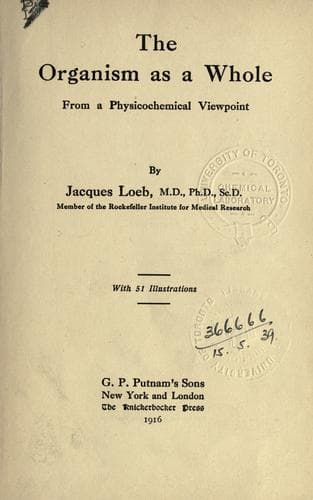
The Organism as a Whole, from a Physicochemical ViewpointLoeb, Jacques
Science
The Organism as a Whole, from a Physicochemical Viewpoint
Loeb, Jacques
Biology; Life (Biology); Mendel's law
Why is it that an animal can in general resist a high temperature
better if the latter is raised gradually than when it is raised
suddenly? Physics offers us an analogy to this phenomenon in the
experience that glass vessels which burst easily when their temperature
is raised suddenly, remain intact when the temperature is raised
gradually. Glass is a poor conductor of heat and when the temperature
is raised suddenly inside a glass cylinder the inner layer of the
cylinder expands while the outer layer on account of the slowness of
conduction of heat does not expand equally and the cylinder may burst.
We might assume that the sudden increase in temperature brings about
certain changes in the cells (_e. g._, an increase in permeability or
destruction of the surface layer?). If the rise of temperature occurs
gradually the blood or lymph or the cell sap may have time to repair
the damage, and this repair seems to be irreversible, at least for
some time, as the experiments on _Fundulus_ seem to indicate. If the
temperature rises too rapidly the damage cannot be repaired quickly
enough by the cell or body liquids.
It is also to be considered that substances might be formed in the body
at a higher temperature which do not exist at a lower temperature, and
_vice versa_, and this might explain results like those of Schottelius
or Dieudonné and many others.
6. The theory of an adapting effect of the environment has often been
linked with the assumption of the inheritance of acquired characters.
The older claims of the hereditary transmission of acquired characters,
such as Brown-Séquard’s epilepsy in guinea pigs after the cutting of
the sciatic nerve, have been shown to be unjustified or have found
a different and more rational explanation. Recently P. Kammerer has
claimed to have proven by new experiments that by environmental
changes, hereditary changes can be produced.
Public-domain text, read in full here on John Shaqi.
Reviews
Reviews
No reviews yet
Be the first to share your thoughts on this work.
Elsewhere in the archive
Join the Discussion
Join the discussion
Sign in to leave a comment or review.
Sign InorCreate an account