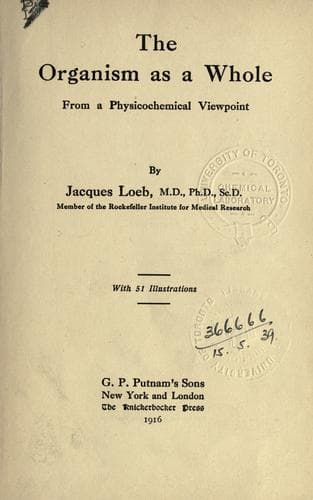
The Organism as a Whole, from a Physicochemical ViewpointLoeb, Jacques
Science
The Organism as a Whole, from a Physicochemical Viewpoint
Loeb, Jacques
Biology; Life (Biology); Mendel's law
1. It is an old saying that we cannot understand life unless we
understand death. The dead body, if its temperature is not too low
and if it contains enough water, undergoes rapid disintegration. It
was natural to argue that life is that which resists this tendency to
disintegration. The older observers thought that the forces of nature
determined the decay, while the vital force resisted it. This idea
found its tersest expression in the definition of Bichat, that “life
is the sum total of the forces which resist death.” Science is not the
field of definitions, but of prediction and control. The problem is:
first, how does it happen that as soon as respiration has ceased only
for a few minutes the human body is dead, that is to say, will commence
to undergo disintegration, and second, what protects the body against
this decay while the respiration goes on, although temperature and
moisture are such as to favour decay?
The earlier biologists had already raised the question why it was that
the stomach and intestine did not digest themselves. The hydrochloric
acid and the pepsin in the stomach and the trypsin in the intestine
digest proteins taken in in the form of food; why do they not digest
the proteins of the cells of the stomach and the intestine? They will
promptly digest the stomach as soon as the individual is dead, but
not during life. A self-digestion may also be caused if the arteries
of the stomach are ligatured. Claude Bernard and others suggested
that the layer of mucus protected the cells of the stomach and of the
intestine from the digestive enzymes; or that the epithelial layer
had a protective effect. Pavy suggested that the alkali of the blood
had a protective action. All these theories became untenable when
Fermi showed that all kinds of living organisms, protozoans, worms,
arthropods, are not digested in solutions of trypsin as long as they
are alive, while they are promptly digested in the same solution
when dead.[294] This is in harmony with the fact that many parasites
live in the intestine without being digested as long as they are
alive. Fermi concluded that the living cell cannot be attacked by the
digestive ferments, while with death a change occurs by which they
can be attacked. But what is this change? Fermi seems to be inclined
to think that the “living molecule” of protein is not hydrolysable
(perhaps because the enzyme cannot attach itself to it?), while a
change in the constitution or configuration of the proteins takes place
after respiration has ceased. The fact that the living cell resists
the digestive action of trypsin and pepsin has found two other modes
of explanation, first, that the cells are surrounded by a membrane or
envelope through which the enzyme cannot diffuse, and second, that the
living cells possess antiferments. But the so-called antiferments are
also said to exist after the death of the cell, whereas after death
the cell is promptly digested. Frédéricq, as well as Klug, has shown
Public-domain text, read in full here on John Shaqi.
Reviews
Reviews
No reviews yet
Be the first to share your thoughts on this work.
Elsewhere in the archive
Join the Discussion
Join the discussion
Sign in to leave a comment or review.
Sign InorCreate an account