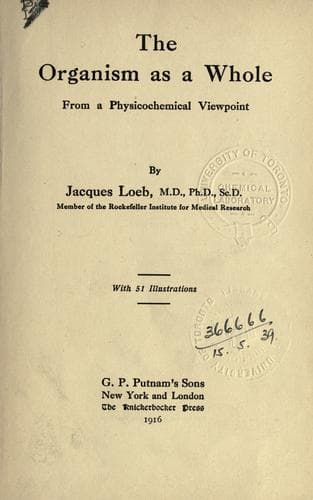
The Organism as a Whole, from a Physicochemical ViewpointLoeb, Jacques
Science
The Organism as a Whole, from a Physicochemical Viewpoint
Loeb, Jacques
Biology; Life (Biology); Mendel's law
Again the question arises: Why do the tissues not undergo autolysis
during lifetime and what protects them, and the answer is that
self-digestion is a consequence of the lack of oxidations. The presence
of antiferments must continue after death and cannot be the cause which
prevents the self-digestion during life, since nothing indicates the
destruction of the hypothetical antidigestive enzymes through lack of
oxygen. The recent work of Bradley and Morse[298] and of Bradley[299]
has thrown some light on the problem. These authors found that proteins
of the liver which are indigestible can be made digestible by the liver
enzymes if an acid salt or a trace of acid is added to the mixture.
A m/200 HCl solution gives marked acceleration of the autodigestion
of the liver. This would explain why autodigestion takes place after
oxidations cease. In many if not all the cells, acids are constantly
formed during lifetime, _e. g._, lactic acid, which through oxidation
are turned to CO₂, and this diffuses into the blood so that the H ion
concentration in the cells does not rise materially. If, however,
the oxidations cease, as is the case after death, the formation of
lactic acid continues, but the acid is not oxidized to CO₂ and thus
removed, and as a consequence the H ion concentration increases in the
cells and the self-digestion of proteins, which the digestive enzymes
contained in the cells themselves could not attack formerly, becomes
possible. Acid increases the digestibility of a protein, probably by
salt formation. Theoretically we should not be surprised that while
in the liver an increase in the C_{H} favours autolysis in other
tissues the same result is produced by the reverse effect. We might
say that the preservation of a certain C_{H} probably at or near the
point of neutrality during life prevents self-digestion, while the
gross alteration of the C_{H} in either direction after death (or
after the cessation of oxidations in the tissues) induces autolysis.
Bradley indeed suggests that many of the phenomena of autolysis during
lifetime, such as atrophy, necrosis, involution, might be due to an
increase in the C_{H} in the tissues.
[298] Bradley, H. C., and Morse, M., _Jour. Biol. Chem._, 1915, xxi.,
209.
[299] Bradley, H. C., _ibid._, 1915, xxii., 113.
These facts agree with the suggestion of Fermi that in the living
cell the proteins cannot be attacked by the digestive enzymes but
relieves us of the necessity of making the monstrous assumption of
a “living molecule” of proteins as distinct from a “dead” molecule.
The difference between life and death is not one between living and
dead molecules, but more likely between the excess of synthetic over
hydrolytic processes.
Public-domain text, read in full here on John Shaqi.
Reviews
Reviews
No reviews yet
Be the first to share your thoughts on this work.
Elsewhere in the archive
Join the Discussion
Join the discussion
Sign in to leave a comment or review.
Sign InorCreate an account