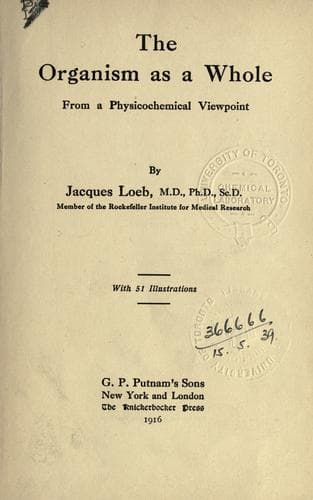
The Organism as a Whole, from a Physicochemical ViewpointLoeb, Jacques
Science
The Organism as a Whole, from a Physicochemical Viewpoint
Loeb, Jacques
Biology; Life (Biology); Mendel's law
7. Metchnikoff[309] has furnished the scientific facts for our
understanding of senescence. He has demonstrated that the changes
in tissue which give rise to phenomena of senility are due to the
action of phagocytes. Thus the ganglion cells are altered (digested?)
and destroyed by “neuronophags” and this is the main cause of mental
senility. Definite phagocytic cells, the osteoclasts, slowly dissolve
the bones (by the excretion of an acid?) and this leads to the known
fragility of the bones in old age. The whiteness of the hair is due to
the action of phagocytes; in the muscles in old age the contractile
elements are destroyed by the sarcoplasm, and so on. It agrees with
these facts that where organs are absorbed in the embryonic development
of an animal, as _e. g._, the tail of the tadpole in metamorphosis,
the phenomenon is due to a process of phagocytosis (and autolysis).
We have mentioned the fact that in the larva of the _Amblystoma_
the absorption of the gills and of the tail occurs simultaneously
and that both must be caused by a constituent of the blood. Such a
constituent may be responsible for phagocytosis and autolysis in
the organs undergoing absorption. Metchnikoff calls attention to
the fact that certain infectious diseases, _e. g._, syphilis, may
bring about precocious senility; and he mentions also the senile
appearance of young cretins which is due to the diseased thyroid. “It
is no mere analogy to suppose that human senescence is the result
of a slow but chronic poisoning of the organism.” He assumes that
in man this poisoning is caused by the products of fermentation in
the large intestine and that the micro-organisms responsible for
these fermentations may therefore be regarded as the real cause of
senility in man. Parrots which are long-lived birds have a limited
flora of microbes in their intestine, while cows and horses which are
short-lived in comparison with man possess an extraordinary richness of
the intestinal flora. But, needless to say, it is not the quantity of
microbes alone which is to be considered, the nature of the microbes is
of much greater importance.
[309] Metchnikoff, E., _The Prolongation of Life_. New York, 1907.
Certain plants like the Californian _Sequoia gigantea_ may be
considered as practically immortal since they live several thousands
of years; other plants, the annuals, die after fructification.
Metchnikoff quotes from a letter by de Vries that this author prolonged
the life of _Œnotheras_ by cutting the flowers before fertilization.
Under ordinary conditions the stem dies after producing from forty
to fifty flowers, but if cutting be practised new flowers are
produced until the winter cold intervenes. By cutting the stem
sufficiently early the plants are induced to develop new buds at
the base and these buds survive winter and resume growth in the
following spring.
Public-domain text, read in full here on John Shaqi.
Reviews
Reviews
No reviews yet
Be the first to share your thoughts on this work.
Elsewhere in the archive
Join the Discussion
Join the discussion
Sign in to leave a comment or review.
Sign InorCreate an account