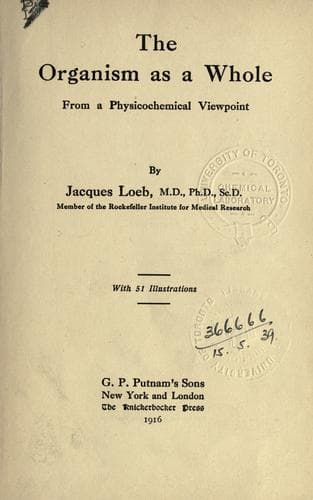
The Organism as a Whole, from a Physicochemical ViewpointLoeb, Jacques
Science
The Organism as a Whole, from a Physicochemical Viewpoint
Loeb, Jacques
Biology; Life (Biology); Mendel's law
[106] Warburg, O., _Sitzungsber. d. Heidelberger Akad. d. Wissnsch._,
B. 1914.
The question remains then: How can membrane formation or the alteration
of the cortical layer underlying membrane formation cause an increase
in the rate of oxidations? One possibility is that the iron (or
whatever the nature of the catalyzer may be) exists in the cortex of
the egg in a masked condition--or in a condition in which it is not
able to act--while the alteration of the cortical layer makes the iron
active. It might be that either the iron or the oxidizable substrate is
contained in the lipoid layer in the unfertilized condition of the egg
and that the destruction or cytolysis of the cortical layer brings both
the iron and the oxidizable substrate into the watery phase in which
they can interact.
Another possibility is that the act of fertilization increases the
permeability of the egg. This idea, which seems attractive, was first
suggested and discussed by the writer in 1906.[107] He had found that
when fertilized and unfertilized eggs were put into abnormal salt
solutions, _e. g._, pure solutions of NaCl, the fertilized eggs died
more rapidly than the unfertilized eggs and he pointed out that these
experiments suggested the possibility that fertilization increases the
permeability of the egg for salts. The reason for his hesitation to
accept this interpretation was, that the fertilized egg is also more
easily injured by lack of oxygen than the unfertilized egg and in this
case the greater sensitiveness of the fertilized egg was obviously due
to its greater rate of metabolism. Later experiments by the writer
showed that the fertilized egg can be made more resistant to abnormal
salt solutions if its development is suppressed by lack of oxygen or
by KCN or by certain narcotics. With our present knowledge it does not
seem very probable that lack of oxygen diminishes the permeability of
the egg, but we know that it inhibits the developmental processes.
Warburg has made it appear very probable that the fertilized egg
is impermeable for NaOH and if this is the case it should also be
impermeable for NaCl.[108]
[107] Loeb, J., _Biochem. Ztschr._, 1906, ii., 87.
[108] Unless the egg is left so long in the pure NaCl solution that its
permeability is increased.
Public-domain text, read in full here on John Shaqi.
Reviews
Reviews
No reviews yet
Be the first to share your thoughts on this work.
Elsewhere in the archive
Join the Discussion
Join the discussion
Sign in to leave a comment or review.
Sign InorCreate an account