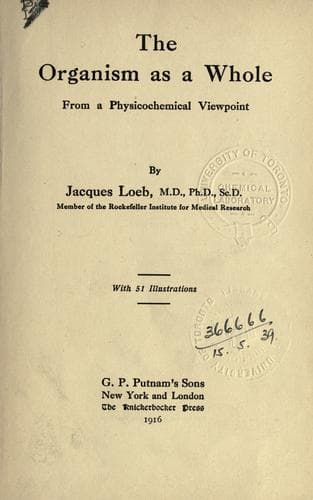
The Organism as a Whole, from a Physicochemical ViewpointLoeb, Jacques
Science
The Organism as a Whole, from a Physicochemical Viewpoint
Loeb, Jacques
Biology; Life (Biology); Mendel's law
8. The most important fact which we gather from these data is that the
cytoplasm of the unfertilized egg may be considered as the embryo in
the rough and that the nucleus has apparently nothing to do with this
predetermination. This must raise the question suggested already in the
third chapter whether it might not be possible that the cytoplasm of
the eggs is the carrier of the genus or even species heredity, while
the Mendelian heredity which is determined by the nucleus adds only
the finer details to the rough block. Such a possibility exists, and if
it should turn out to be true we should come to the conclusion that the
unity of the organism is not due to a putting together of a number of
independent Mendelian characters according to a “pre-established plan,”
but to the fact that the organism in the rough existed already in the
cytoplasm of the egg before the egg was fertilized. The influence of
the hereditary Mendelian factors or genes consisted only in impressing
the numerous details upon the rough block and in thus determining its
variety and individuality; and this could be accomplished by substances
circulating in the liquids of the body as we shall see in later
chapters.
CHAPTER VII
REGENERATION
1. The action of the organism as a whole seems nowhere more pronounced
than in the phenomena of regeneration, for it is the organism as a
whole which represses the phenomena of regeneration in its parts, and
it is the isolation of the part from the influence of the whole which
sets in action the process of regeneration. The leaf of the Bermuda
“life plant”--_Bryophyllum calycinum_--behaves like any other leaf as
long as it is part of a healthy whole plant, while when isolated it
gives rise to new plants. The power of so doing was possessed by the
leaf while a part of the whole, and it was the “whole” which suppressed
the formative forces in the leaf. When a piece is cut from the branch
of a willow it forms roots near the lower end and shoots at the upper
end, so that a tolerably presentable “whole” is restored. How does the
“whole” prevent the basal end of the shoot from forming roots as long
as it is part of the plant? A certain fresh-water flatworm has the
mouth and pharynx in the middle of the body. When a piece is excised
between the head and the pharynx a new head is formed at the oral end,
a new tail at the opposite end, and in the middle of the remaining old
tissue a new mouth and pharynx is formed. How does the “whole” suppress
all this formative power in the part before the latter is isolated? It
almost seems as if the isolation itself were the emancipation of the
part from the tyranny of the whole. The explanation of this tyranny or
of the correlation of the parts in the whole is to be found, however,
in a different influence. The earlier botanists, Bonnet, Dutrochet, and
especially Sachs,[142] pointed out that the phenomena of correlation
are determined by the flow of sap in the body of a plant. These authors
Public-domain text, read in full here on John Shaqi.
Reviews
Reviews
No reviews yet
Be the first to share your thoughts on this work.
Elsewhere in the archive
Join the Discussion
Join the discussion
Sign in to leave a comment or review.
Sign InorCreate an account