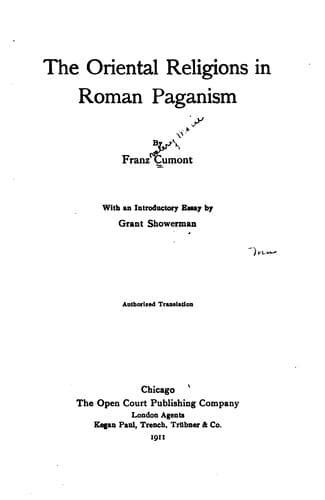
The Oriental Religions in Roman PaganismCumont, Franz
Religion
The Oriental Religions in Roman Paganism
Cumont, Franz
Paganism -- Rome; Religions; Rome -- Religion
Thus the basis of the religion of the magi of Asia Minor was Mazdaism,
somewhat changed from that of the Avesta, and in certain respects holding
closer to the primitive nature worship of the Aryans, but nevertheless a
clearly characterized and distinctive Mazdaism, which was to remain the
most solid foundation for the greatness of the mysteries of Mithra in the
Occident.
Recent discoveries[21] of bilingual inscriptions have succeeded in
establishing the fact that the language used, or at least written, by the
Persian colonies of Asia Minor was not their ancient Aryan idiom, but {146}
Aramaic, which was a Semitic dialect. Under the Achemenides this was the
diplomatic and commercial language of all countries west of the Tigris. In
Cappadocia and Armenia it remained the literary and probably also the
liturgical language until it was slowly supplanted by Greek during the
Hellenistic period. The very name _magousaioi_ ([Greek: magousaioi]) given
to the magi in those countries is an exact transcription of a Semitic
plural.[22] This phenomenon, surprising at first sight, is explained by the
history of the _magousaioi_ who emigrated to Asia Minor. They did not come
there directly from Persepolis or Susa, but from Mesopotamia. Their
religion had been deeply influenced by the speculations of the powerful
clergy officiating in the temples of Babylon. The learned theology of the
Chaldeans imposed itself on the primitive Mazdaism, which was a collection
of traditions and rites rather than a body of doctrines. The divinities of
the two religions became identified, their legends connected, and the
Semitic astrology, the result of long continued scientific observations,
superimposed itself on the naturalistic myths of the Persians. Ahura Mazda
was assimilated to Bel, Anahita to Ishtar, and Mithra to Shamash, the solar
god. For that reason Mithra was commonly called _Sol invictus_ in the Roman
mysteries, and an abstruse and a complicated astronomic symbolism was
always part of the teachings revealed to candidates for initiation and
manifested itself also in the artistic embellishments of the temple.
Public-domain text, read in full here on John Shaqi.
Reviews
Reviews
No reviews yet
Be the first to share your thoughts on this work.
Elsewhere in the archive
Join the Discussion
Join the discussion
Sign in to leave a comment or review.
Sign InorCreate an account