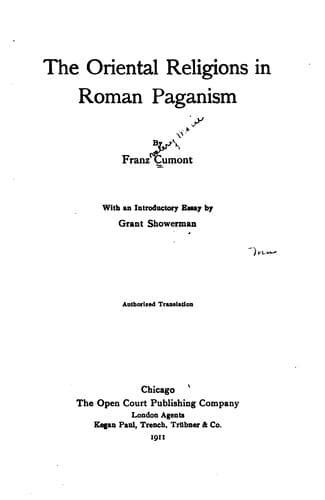
The Oriental Religions in Roman PaganismCumont, Franz
Religion
The Oriental Religions in Roman Paganism
Cumont, Franz
Paganism -- Rome; Religions; Rome -- Religion
In addition to respect for authority it preached fraternity. All the
initiates considered themselves as sons of the same father owing to one
another a brother's affection. It is a question whether they extended the
love of neighbor to that universal charity taught by philosophy and
Christianity. Emperor Julian, a devoted mystic, liked to set up such an
ideal, and it is probable that the Mithraists of later paganism rose to
this conception of duty,[49] but they were not its authors. They seemed to
have attached more importance to the virile qualities than to compassion
and gentleness. The fraternal spirit of initiates calling themselves
soldiers was doubtless more akin to the spirit of comradeship in a regiment
that has _esprit de corps_, than to the love of one's neighbor that
inspires works of mercy towards all.
All primitive people imagine nature filled with unclean and wicked spirits
that corrupt and torture those who disturb their repose; but dualism
endowed this universal belief with marvelous power as well as with a
dogmatic basis. Mazdaism is governed throughout by ideas of purity and
impurity. "No religion on earth has ever been so completely dominated by an
ideal of purification."[50] This kind of perfection was the goal of the
aspiration and effort of believers. They were obliged to guard with
infinite precaution against defiling the divine elements, for instance
water or fire, or their own persons, and to wipe out all pollution by {157}
repeated lustrations. But, as in the Syrian cults of the imperial period,
these Mithraic rites did remain simply formal, mechanical and of the flesh,
inspired by the old idea of _tabu_. Mithraic baptism wiped out moral
faults; the purity aimed at had become spiritual.
This perfect purity distinguishes the mysteries of Mithra from those of all
other Oriental gods. Serapis is the brother and husband of Isis, Attis the
lover of Cybele, every Syrian Baal is coupled with a spouse; but Mithra
lives alone. Mithra is chaste, Mithra is holy (_sanctus_),[51] and for the
worship of fecundity he substitutes a new reverence for continence.
Public-domain text, read in full here on John Shaqi.
Reviews
Reviews
No reviews yet
Be the first to share your thoughts on this work.
Elsewhere in the archive
Join the Discussion
Join the discussion
Sign in to leave a comment or review.
Sign InorCreate an account