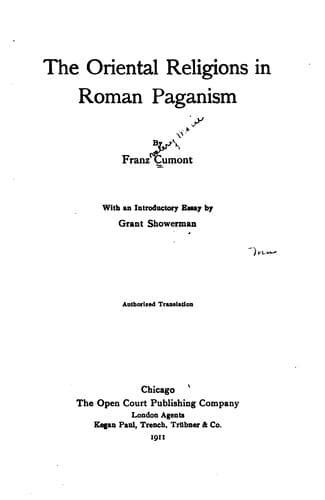
The Oriental Religions in Roman PaganismCumont, Franz
Religion
The Oriental Religions in Roman Paganism
Cumont, Franz
Paganism -- Rome; Religions; Rome -- Religion
Originally the adepts in this dubious art were {187} despised. As late as
the period of Augustus they were generally equivocal beggar-women who plied
their miserable trade in the lowest quarters of the slums. But with the
invasion of the Oriental religions the magician began to receive more
consideration, and his condition improved.[62] He was honored, and feared
even more. During the second century scarcely anybody would have doubted
his power to call up divine apparitions, converse with the superior spirits
and even translate himself bodily into the heavens.[63]
Here the victorious progress of the Oriental religions shows itself. The
Egyptian ritual[64] originally was nothing but a collection of magical
practices, properly speaking. The religious community imposed its will upon
the gods by means of prayers or even threats. The gods were compelled to
obey the officiating priest, if the liturgy was correctly performed, and if
the incantations and the magic words were pronounced with the right
intonation. The well-informed priest had an almost unlimited power over all
supernatural beings on land, in the water, in the air, in heaven and in
hell. Nowhere was the gulf between things human and things divine smaller,
nowhere was the increasing differentiation that separated magic from
religion less advanced. Until the end of paganism they remained so closely
associated that it is sometimes difficult to distinguish the texts of one
from those of the other.
The Chaldeans[65] also were past masters of sorcery, well versed in the
knowledge of presages and experts in conjuring the evils which the presages
foretold. In Mesopotamia, where they were confidential advisers of the
kings, the magicians belonged to the official {188} clergy; they invoked
the aid of the state gods in their incantations, and their sacred science
was as highly esteemed as haruspicy in Etruria. The immense prestige that
continued to surround it, assured its persistence after the fall of Nineveh
and Babylon. Its tradition was still alive under the Caesars, and a number
of enchanters rightly or wrongly claimed to possess the ancient wisdom of
Chaldea.[66]
And the thaumaturgus, who was supposed to be the heir of the archaic
priests, assumed a wholly sacerdotal appearance at Rome. Being an inspired
sage who received confidential communications from heavenly spirits, he
gave to his life and to his appearance a dignity almost equal to that of
the philosopher. The common people soon confused the two,[67] and the
Orientalizing philosophy of the last period of paganism actually accepted
and justified all the superstitions of magic. Neo-Platonism, which
concerned itself to a large extent with demonology, leaned more and more
towards theurgy, and was finally completely absorbed by it.
Public-domain text, read in full here on John Shaqi.
Reviews
Reviews
No reviews yet
Be the first to share your thoughts on this work.
Elsewhere in the archive
Join the Discussion
Join the discussion
Sign in to leave a comment or review.
Sign InorCreate an account