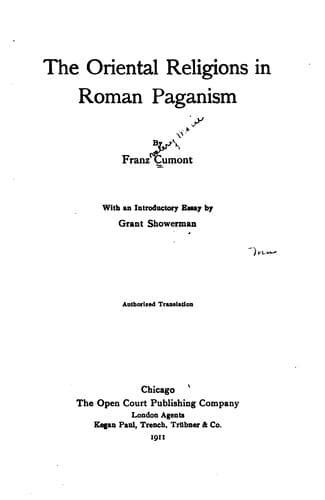
The Oriental Religions in Roman PaganismCumont, Franz
Religion
The Oriental Religions in Roman Paganism
Cumont, Franz
Paganism -- Rome; Religions; Rome -- Religion
At a somewhat later period arrived the numerous and varied Baals of Syria.
The great economic movement starting at the beginning of our era which
produced the colonization of the Latin world by Syrian slaves and
merchants, not only modified the material civilization of Europe, but also
its conceptions and beliefs. The Semitic cults entered into successful
competition with those of Asia Minor and Egypt. They may not have had so
stirring a liturgy, nor have been so thoroughly absorbed in preoccupation
with a future {199} life, although they taught an original eschatology, but
they did have an infinitely higher idea of divinity. The Chaldean
astrology, of which the Syrian priests were enthusiastic disciples, had
furnished them with the elements of a scientific theology. It had led them
to the notion of a God residing far from the earth above the zone of the
stars, a God almighty, universal and eternal. Everything on earth was
determined by the revolutions of the heavens according to infinite cycles
of years. It had taught them at the same time the worship of the sun, the
radiant source of earthly life and human intelligence.
The learned doctrines of the Babylonians had also imposed themselves upon
the Persian mysteries of Mithra which considered time identified with
heaven as the supreme cause, and deified the stars; but they had
superimposed themselves upon the ancient Mazdean creed without destroying
it. Thus the essential principles of the religion of Iran, the secular and
often successful rival of Greece, penetrated into the Occident under cover
of Chaldean wisdom. The Mithra worship, the last and highest manifestation
of ancient paganism, had Persian dualism for its fundamental dogma. The
world is the scene and the stake of a contest between good and evil, Ormuzd
and Ahriman, gods and demons, and from this primary conception of the
universe flowed a strong and pure system of ethics. Life is a combat;
soldiers under the command of Mithra, invincible heroes of the faith, must
ceaselessly oppose the undertakings of the infernal powers which sow
corruption broadcast. This imperative ethics was productive of energy and
formed the characteristic {200} feature distinguishing Mithraism from all
other Oriental cults.
Thus every one of the Levantine countries--and that is what we meant to
show in this brief recapitulation--had enriched Roman paganism with new
beliefs that were frequently destined to outlive it. What was the result of
this confusion of heterogeneous doctrines whose multiplicity was extreme
and whose values were very different? How did the barbaric ideas refine
themselves and combine with each other when thrown into the fiery crucible
of imperial syncretism? In other words, what shape was assumed by ancient
idolatry, so impregnated with exotic theories during the fourth century,
when it was finally dethroned? It is this point that we should like to
indicate briefly as the conclusion to these studies.
Public-domain text, read in full here on John Shaqi.
Reviews
Reviews
No reviews yet
Be the first to share your thoughts on this work.
Elsewhere in the archive
Join the Discussion
Join the discussion
Sign in to leave a comment or review.
Sign InorCreate an account