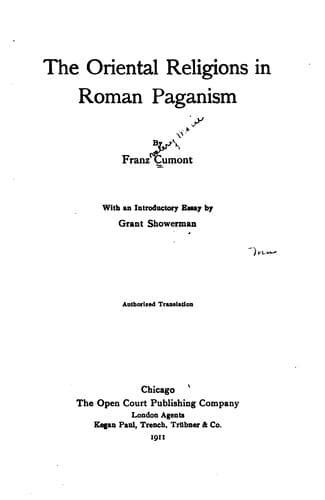
The Oriental Religions in Roman PaganismCumont, Franz
Religion
The Oriental Religions in Roman Paganism
Cumont, Franz
Paganism -- Rome; Religions; Rome -- Religion
At the other extreme of society the philosophers delighted in veiling
religion with the frail and brilliant tissue of their speculations. Like
the emperor Julian they improvised bold and incongruous interpretations of
the myth of the Great Mother, and these interpretations were received and
relished by a restricted circle of scholars. But during the fourth century
these vagaries of the individual imagination were nothing but arbitrary
applications of uncontested principles. During that century there was much
less intellectual anarchy than when Lucian had exposed the sects "for sale
at public auction"; a comparative harmony arose among the pagans after they
joined the opposition. One single school, that of neo-Platonism, ruled all
{202} minds. This school not only respected positive religion, as ancient
stoicism had done, but venerated it, because it saw there the expression of
an old revelation handed down by past generations. It considered the sacred
books divinely inspired--the books of Hermes Trismegistus, Orpheus, the
Chaldean oracles, Homer, and especially the esoteric doctrines of the
mysteries--and subordinated its theories to their teachings. As there must
be no contradiction between all the disparate traditions of different
countries and different periods, because all have emanated from one
divinity, philosophy, the _ancilla theologiae_, attempted to reconcile them
by the aid of allegory. And thus, by means of compromises between old
Oriental ideas and Greco-Latin thought, an _ensemble_ of beliefs slowly
took form, the truth of which seemed to have been established by common
consent. So when the atrophied parts of the Roman religion had been
removed, foreign elements had combined to give it a new vigor and in it
themselves became modified. This hidden work of internal decomposition and
reconstruction had unconsciously produced a religion very different from
the one Augustus had attempted to restore.
Public-domain text, read in full here on John Shaqi.
Reviews
Reviews
No reviews yet
Be the first to share your thoughts on this work.
Elsewhere in the archive
Join the Discussion
Join the discussion
Sign in to leave a comment or review.
Sign InorCreate an account