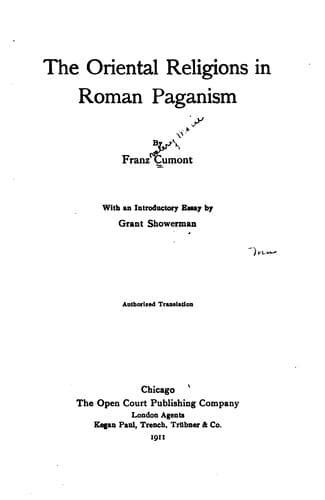
The Oriental Religions in Roman PaganismCumont, Franz
Religion
The Oriental Religions in Roman Paganism
Cumont, Franz
Paganism -- Rome; Religions; Rome -- Religion
10. This result is especially due to the researches of M. Strzygowski, but
we cannot enter here into the controversies aroused by his publications:
_Orient oder Rom_, 1911; _Hellas in des Orients Umarmung_, Munich, 1902,
and especially _Kleinasien, ein Neuland der Kunstgeschichte_, Leipsic,
1903; [cf. the reports of Ch. Diehl, _Journal des Savants_, 1904, pp. 236
ff. = _Etudes byzantines_, 1905, pp. 336 ff.; Gabriel Millet, _Revue
archeolog._, 1905, I, pp. 93 ff.; Marcel Laurent, _Revue de l'Instr. publ.
en Belgique_, 1905, pp. 145 ff.]; _Mschatta_, 1904, [cf. _infra_, Ch. VI,
n. 12].--M. Brehier, "Orient ou Byzance?" (_Rev. archeol._, 1907, II, pp.
396 ff.), gives a substantial summary of the question.--In his last volume,
_Amida_ (1910), M. {216} Strzygowski tries to find the source of medieval
art in Mesopotamia. For this controversy see Diehl's _Manuel d'art
byzantin_, 1910.
11. See also Pliny, _Epist. Traian._, 40: "Architecti tibi [in Bithynia]
deesse non possunt ... cum ex Graecia etiam ad nos [at Rome] venire soliti
sint."--Among the names of architects mentioned in Latin inscriptions there
are a great many revealing Greek or Oriental origin (see Ruggiero, _Dizion.
epigr._, s. v. "Architectus"), in spite of the consideration which their
eminently useful profession always enjoyed at Rome.
12. The question of the artistic and industrial influences exercised by the
Orient over Gaul during the Roman period, has been broached
frequently--among others by Courajod (_Lecons du Louvre_, I, 1899, pp. 115,
327 ff.)--but it has never been seriously studied in its entirety.
Michaelis has recently devoted a suggestive article to this subject in
connection with a statue from the museum of Metz executed in the style of
the school of Pergamum (_Jahrb. der Gesellsch. fuer lothring. Geschichte_,
XVII, 1905, pp. 203 ff.). By the influence of Marseilles in Gaul, and the
ancient connection of that city with the towns of Hellenic Asia, he
explains the great difference between the works of sculpture discovered
along the upper Rhine, which had been civilized by the Italian legions, and
those unearthed on the other side of the Vosges. This is a very important
discovery, rich in results. We believe, however, that Michaelis ascribes
too much importance to the early Marseilles traders traveling along the old
"tin road" towards Brittany and the "amber road" towards Germany. The
Asiatic merchants and artisans did not set out from one point only. There
were many emigrants all over the valley of the Rhone. Lyons was a
half-Hellenized city, and the relations of Arles with Syria, of Nimes with
Egypt, etc., are well known. We shall speak of them in connection with the
religions of those countries.
13. Even in the bosom of the church the Latin Occident of the fourth
century was still subordinate to the Greek Orient, which imposed its
doctrinal problems upon it (Harnack, _Mission und Ausbreitung_, II, p. 283,
n. 1).
Public-domain text, read in full here on John Shaqi.
Reviews
Reviews
No reviews yet
Be the first to share your thoughts on this work.
Elsewhere in the archive
Join the Discussion
Join the discussion
Sign in to leave a comment or review.
Sign InorCreate an account