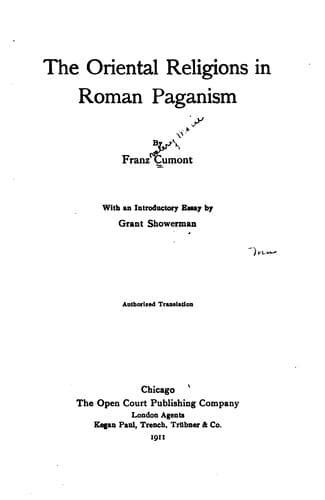
The Oriental Religions in Roman PaganismCumont, Franz
Religion
The Oriental Religions in Roman Paganism
Cumont, Franz
Paganism -- Rome; Religions; Rome -- Religion
43. Even in the regions where the cities developed, the Baal and the Baalat
always remained the divinities [Greek: poliouchoi], the protectors of the
city which they were supposed to have founded.
44. Le Bas-Waddington, 2196.--Suidas, s. v. [Greek: Phularches] (II, 2,
col. 1568, Bernhardy). Cf. Marquardt, _Staatsverwaltung_, I, p. 405, 409.
45. Hippolytus, Adv. Haeres., V, II, Sec. 7: [Greek: Assurion teletai]; Sec. 18:
[Greek: Assurion musteria] (pp. 145, 148, ed. by Cruice). Cf. Origen,
_Contra Celsum_, I, 12. Pognon (_Inscrip. semitiques_, {249} 1907, No. 48)
has recently published a Syrian epitaph that is unfortunately mutilated,
but which seems to be that of an adept of the pagan mysteries; see Noeldeke,
_Zeitschrift fuer Assyr._, XXI, 1907, p. 155.
46. On the Semitic notion of purity, W. Robertson Smith has written
admirably and convincingly (pp. 446 ff. and _passim_). The question has
been taken up from a different point of view by Lagrange, pp. 141 ff.--The
development of the notion of purity in the ancient religions has been
recently expounded by Farnell, _The Evolution of Religion_, 1905, pp. 88
ff., especially pp. 124 ff. Cf. also _supra_, p. 91 f. An example of the
prohibitions and purifications is found in the Occident in an inscription,
unfortunately mutilated, discovered at Rome and dedicated to Beellefarus
(_CIL_, VI, 30934, 31168; cf. Lafaye, _Rev. hist. relig._, XVII, 1888, pp.
218 ff.; Dessau, _Inscr. sel._, 4343). If I have understood the text
correctly it commands those who have eaten pork to purify themselves by
means of honey.--On penances in the Syrian religions see ch. II, n. 31.
47. M. Clermont-Ganneau (_Etudes d'archeologie orientale_, II, 1896, p.
104) states that the epithet [Greek: hagios] is extremely rare in pagan
Hellenism, and almost always betrays a Semitic influence. In such cases it
corresponds to [Hebrew: QRSH], which to the Semites is the epithet _par
excellence_ of the divinity. Thus Eshmon is [Hebrew: QRSH]; cf. Lidzbarski,
_Ephemer. fuer semit. Epigraph._, II, p. 155; Clermont-Ganneau, _Recueil
d'archeol. orient._, III, p. 330; V, p. 322.--In Greek Le Bas-Waddington,
2720, has: [Greek: Oi katochoi hagiou ouraniou Dios]. Dittenberger,
_Orientis inscript._, 620, [Greek: Zeus hagios Beel bosoros]. Some time ago
I copied at a dealer's, a dedication engraved upon a lamp: [Greek: Theoi
hagioi Arelseloi], in Latin: J. Dolichenus _sanctus_, _CIL_, VI, 413, X,
7949.--J. Heliopolitanus _sanctissimus_, _CIL_, VIII, 2627.--"Caelestis
_sancta_," VIII, 8433, etc.--The African Saturn (= Baal) is often called
_sanctus_.--_Hera sancta_ beside Jupiter Dolichenus, VI, 413.--Malakbel is
translated by _Sol sanctissimus_, in the bilingual inscription of the
Capitol, VI, 710 = Dessau, 4337. Cf. _deus sanctus aeternus_, V, 1058,
3761, and _Comptes Rendus Acad. Inscr._, 1906, p. 69.--See in general
Delehaye, _Analecta Bollandiana_, 1909, pp. 157 ff. {250}
Public-domain text, read in full here on John Shaqi.
Reviews
Reviews
No reviews yet
Be the first to share your thoughts on this work.
Elsewhere in the archive
Join the Discussion
Join the discussion
Sign in to leave a comment or review.
Sign InorCreate an account