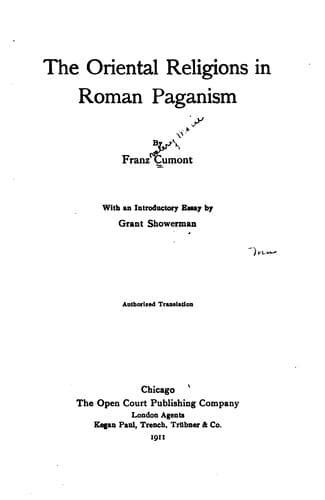
The Oriental Religions in Roman PaganismCumont, Franz
Religion
The Oriental Religions in Roman Paganism
Cumont, Franz
Paganism -- Rome; Religions; Rome -- Religion
59. Cf. Wissowa, _op. cit._, p. 306-7.--On the temple of Bel at Palmyra,
cf. Sobernheim, _Palmyrenische Inschriften_ (_Mitt. der vorderasiat.
Gesellsch._, X), 1905, pp. 319 ff.; Lidzbarski, _Ephemeris_, I, pp. 255
ff., II, p. 280.--Priests of Bel: Clermont-Ganneau, _Recueil d'arch.
orient._, VII, p. 12, 24, 364. Cf. _supra_, n. 54. The power of Palmyra
under Zenobia, who ruled from the Tigris to the Nile, must have had as a
corollary the establishment of an official worship that was necessarily
syncretic. Hence its special importance for the history of paganism.
Although the Babylonian astrology was a powerful factor in this worship,
Judaism seems to have had just as great an influence in its formation.
There was at Palmyra a large Jewish colony, which the writers of the Talmud
considered only tolerably orthodox (Chaps, _Gli Ebrei di Palmira_ [_Rivista
Israelitica_, I], Florence, 1904, pp. 171 ff., 238 f. Cf. "Palmyra" in the
_Jewish Encycl._; Jewish insc. of Palmyra; Euting, _Sitzb. Berl. Acad._,
1885, p. 669; Landauer, _ibid._, 1884, pp. 933 ff.). This colony seems to
have made compromises with the idolaters. On the other hand we see Zenobia
herself rebuilding a synagogue in Egypt (_Revue archeologique_, XXX, 1875,
p. III; _Zeitschrift fuer Numismatik_, V, p. 229; Dittenberger, _Orientis
inscript._, 729). This influence of Judaism seems to explain the
development at Palmyra of the cult of [Greek: Zeus hupsitos kai epekoos],
"he whose name is blessed in eternity." The name of Hypsistos has been
applied everywhere to Jehovah and to the pagan Zeus (_supra_, p. 62, 128)
at the same time. The text of Zosimus (I, 61), according to which Aurelian
brought from Palmyra to Rome the statues of [Greek: Heliou te kai Belou]
(this has been wrongly changed to read [Greek: tou kai Belou]), proves that
the {253} astrological religion of the great desert city recognized a
supreme god residing in the highest heavens, and a solar god, his visible
image and agent, according to the Semitic theology of the last period of
paganism (_supra_, p. 134).
60. I have spoken of this solar eschatology in the memorial cited _infra_,
n. 88.
61. This opinion is that of Posidonius (see Wendland, _Philos Schrift ueber
die Vorsehung_, Berlin, 1892, p. 68, n. 1; 70, n. 2). It is shared by the
ancient astrologers.
62. This old pagan and gnostic idea has continued to the present day in
Syria among the Nosairis; cf. Dussaud, _Histoire et religion des Nosairis_,
1900, p. 125.
63. The belief that pious souls are guided to heaven by a psychopompus, is
found not only in the mysteries of Mithra (_Mon. myst. Mithra_, I, p. 310),
but also in the Syrian cults where that role was often assigned to the
solar god, see Isid. Levy, _Cultes syriens dans le Talmud_ (_Revue des
etudes juives_, XLIII), 1901, p. 5, and Dussaud, _Notes_, p. 27; cf. the Le
Bas-Waddington inscription, 2442:
Public-domain text, read in full here on John Shaqi.
Reviews
Reviews
No reviews yet
Be the first to share your thoughts on this work.
Elsewhere in the archive
Join the Discussion
Join the discussion
Sign in to leave a comment or review.
Sign InorCreate an account