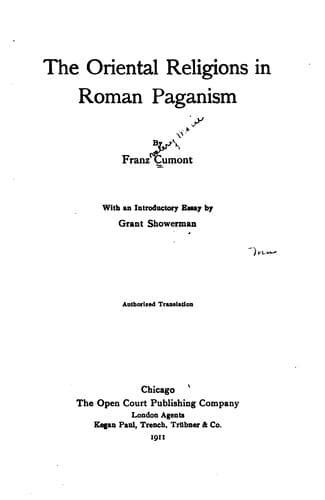
The Oriental Religions in Roman PaganismCumont, Franz
Religion
The Oriental Religions in Roman Paganism
Cumont, Franz
Paganism -- Rome; Religions; Rome -- Religion
It was adopted wherever the authority or the prestige of the Lagides was
felt, and wherever the relations of Alexandria, the great commercial
metropolis, extended. The Lagides induced the rulers and the nations with
whom they concluded alliances to accept it. King Nicocreon introduced it
into Cyprus after having consulted the oracle of the Serapeum,[12] and
Agathocles introduced it into Sicily, at the time of his marriage with the
daughter-in-law of Ptolemy I (298).[13] At Antioch, Seleucus Callinicus
built a sanctuary for the statue of Isis sent to him from Memphis by
Ptolemy Euergetes.[14] In token of his friendship Ptolemy Soter introduced
his god Serapis into Athens, where the latter had a temple at the foot of
the Acropolis[15] ever after, and Arsinoe, his mother or wife, founded
another at Halicarnassus, about the year 307.[16] In this manner the
political activity of the Egyptian dynasty was directed toward having the
divinities, whose glory was in a certain measure connected with that of
their house, recognized everywhere. Through Apuleius we know that under the
empire the priests of Isis mentioned the ruling sovereign first of all in
their prayers.[17] And this was simply an imitation of the grateful
devotion which their predecessors had felt toward the Ptolemies.
Protected by the Egyptian squadrons, sailors and merchants propagated the
worship of Isis, the goddess of navigators, simultaneously on the coasts of
Syria, {80} Asia Minor and Greece, in the islands of the Archipelago,[18]
and as far as the Hellespont and Thrace.[19] At Delos, where the
inscriptions enable us to study this worship somewhat in detail, it was not
merely practised by strangers, but the very sacerdotal functions were
performed by members of the Athenian aristocracy. A number of funereal
bas-reliefs, in which the deified dead wears the _calathos_ of Serapis on
his head, prove the popularity of the belief in future life propagated by
these mysteries. According to the Egyptian faith he was identified with the
god of the dead.[20]
Even after the splendor of the court of Alexandria had faded and vanished;
even after the wars against Mithridates and the growth of piracy had ruined
the traffic of the AEgean Sea, the Alexandrian worship was too deeply rooted
in the soil of Greece to perish, although it became endangered in certain
seaports like Delos. Of all the gods of the Orient, Isis and Serapis were
the only ones that retained a place among the great divinities of the
Hellenic world until the end of paganism.[21]
* * * * *
Public-domain text, read in full here on John Shaqi.
Reviews
Reviews
No reviews yet
Be the first to share your thoughts on this work.
Elsewhere in the archive
Join the Discussion
Join the discussion
Sign in to leave a comment or review.
Sign InorCreate an account