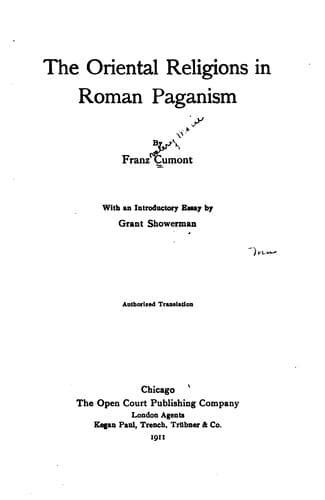
The Oriental Religions in Roman PaganismCumont, Franz
Religion
The Oriental Religions in Roman Paganism
Cumont, Franz
Paganism -- Rome; Religions; Rome -- Religion
If, then, the deceased had piously served Osiris-Serapis, he was
assimilated to that god, and shared his immortality in the underworld,
where the judge of the dead held forth. He lived not as a tenuous shade or
as a subtle spirit, but in full possession of his body as well as of his
soul. That was the Egyptian doctrine, and that certainly was also the
doctrine of the Greco-Latin mysteries.[82]
Through the initiation the mystic was born again, but to a superhuman life,
and became the equal of the immortals.[83] In his ecstasy he imagined that
he was crossing the threshold of death and contemplating the gods of heaven
and hell face to face.[84] If he had accurately followed the prescriptions
imposed upon him by Isis and Serapis through their priests, those gods
prolonged his life after his decease beyond the duration assigned to it by
destiny, and he participated eternally in their beatitude and offered them
his homage in their realm.[85] The "unspeakable pleasure" he felt when
contemplating the sacred images in the temple[86] became perpetual rapture
when he was in the divine presence instead of in the presence of the image,
and drawn close to divinity his thirsting soul enjoyed the delights of that
ineffable beauty.[87]
When the Alexandrian mysteries spread over Italy under the republic, no
religion had ever brought to mankind so formal a promise of blest
immortality as these, and this, more than anything else, lent them an {101}
irresistible power of attraction. Instead of the vague and contradictory
opinions of the philosophers in regard to the destiny of the soul, Serapis
offered certainty founded on divine revelation corroborated by the faith of
the countless generations that had adhered to it. What the votaries of
Orpheus had confusedly discovered through the veil of the legends, and
taught to Magna Grecia,[88] namely, that this earthly life was a trial, a
preparation for a higher and purer life, that the happiness of an
after-life could be secured by means of rites and observances revealed by
the gods themselves, all this was now preached with a firmness and
precision hitherto unknown. These eschatological doctrines in particular,
helped Egypt to conquer the Latin world and especially the miserable
masses, on whom the weight of all the iniquities of Roman society rested
heavily.
* * * * *
The power and popularity of that belief in future life has left traces even
in the French language, and in concluding this study, from which I have
been compelled to exclude every picturesque detail, I would like to point
out how a French word of to-day dimly perpetuates the memory of the old
Egyptian ideas.
Public-domain text, read in full here on John Shaqi.
Reviews
Reviews
No reviews yet
Be the first to share your thoughts on this work.
Elsewhere in the archive
Join the Discussion
Join the discussion
Sign in to leave a comment or review.
Sign InorCreate an account