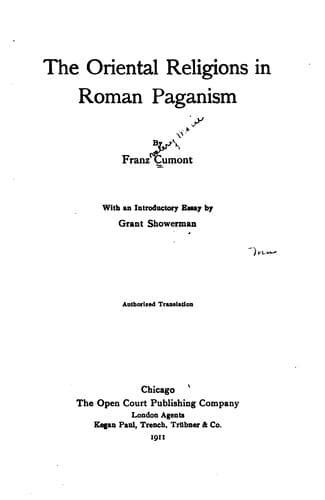
The Oriental Religions in Roman PaganismCumont, Franz
Religion
The Oriental Religions in Roman Paganism
Cumont, Franz
Paganism -- Rome; Religions; Rome -- Religion
Beginning with the second century before Christ, merchants began to import
Syrian slaves. At that time Delos was the great trade center in this human
commodity, and in that island especially Atargatis was worshiped by
citizens of Athens and Rome.[4] Trade spread her worship in the
Occident.[5] We know that the great slave revolution that devastated Sicily
in 134 B. C. was started by a slave from Apamea, a votary of the Syrian
goddess. Simulating divine madness, he called his companions to arms,
pretending to act in accordance with orders from heaven.[6] This detail,
which we know by chance, shows how considerable a proportion of Semites
there was in the gangs working the fields, and how much authority Atargatis
enjoyed in the rural centers. Being too poor to build temples for their
national goddess, those agricultural laborers {106} waited with their
devotions until a band of itinerant _galli_ passed through the distant
hamlet where the lot of the auction had sent them. The existence of those
wandering priests depended, therefore, on the number of fellow-countrymen
they met in the rural districts, who supported them by sacrificing a part
of their poor savings.
Towards the end of the republic those diviners appear to have enjoyed
rather serious consideration at Rome. It was a pythoness from Syria that
advised Marius on the sacrifices he was to perform.[7]
Under the empire the importation of slaves increased. Depopulated Italy
needed more and more foreign hands, and Syria furnished a large quota of
the forced immigration of cultivators. But those Syrians, quick and
intelligent as they were strong and industrious, performed many other
functions. They filled the countless domestic positions in the palaces of
the aristocracy and were especially appreciated as litter-bearers.[8] The
imperial and municipal administrations, as well as the big contractors to
whom customs and the mines were farmed out, hired or bought them in large
numbers, and even in the remotest border provinces the _Syrus_ was found
serving princes, cities or private individuals. The worship of the Syrian
goddess profited considerably by the economic current that continually
brought new worshipers. We find her mentioned in the first century of our
era in a Roman inscription referring in precise terms to the slave market,
and we know that Nero took a devout fancy to the stranger that did not,
however, last very long.[9] In the popular Trastevere quarter she had a
temple until the end of paganism.[10] {107}
During the imperial period, however, the slaves were no longer the only
missionaries that came from Syria, and Atargatis was no longer the only
divinity from that country to be worshiped in the Occident. The propagation
of the Semitic worship progressed for the most part in a different manner
under the empire.
Public-domain text, read in full here on John Shaqi.
Reviews
Reviews
No reviews yet
Be the first to share your thoughts on this work.
Elsewhere in the archive
Join the Discussion
Join the discussion
Sign in to leave a comment or review.
Sign InorCreate an account