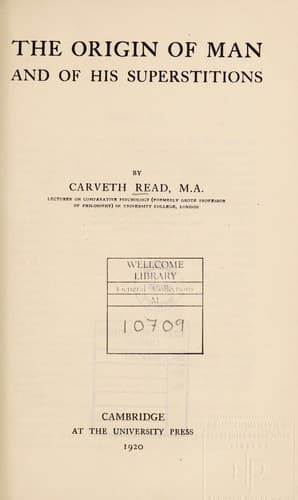
The Origin of Man and of His SuperstitionsRead, Carveth
Philosophy
The Origin of Man and of His Superstitions
Read, Carveth
Animism; Human beings -- Origin; Magic; Superstition; Totemism
(1) We may reasonably assume that the simplest magical beliefs and
practices are of the earliest type: and nothing can be simpler than the
belief in charms, rites and spells. It is, indeed, difficult to find
many of these practices—though some can be produced—in their simplest
forms in our records of backward peoples; partly because they have
not been enough observed; partly because Magic is apt everywhere to
become saturated with Animism; partly because charms, rites and spells
are generally, for greater efficacy, compounded with one another. But
these considerations do not affect the simplicity of the idea involved
in the magical beliefs; which is merely this, that a certain object by
its presence, or that an action, or an utterance, by merely entering
into the course of events, will serve our purpose. A bare uniformity
of connexion—if _A_, then _B_—in accordance with the familiar
ongoings of Nature and our common activities, is all that is assumed.
Many kinds of obstacles stop an arrow or a dart; carrion collects the
vultures: so a patterned comb in one’s hair stops the demon of disease;
a patterned quiver, or a certain song, brings the monkeys down from
the tree-tops.[102] A spell assumes merely that certain objects,
or animals, or spirits, must always comply with a wish or command
expressed in words, just as another human being often does. It is their
supposed uniform coerciveness that makes the words magical. If any
form of words ever seems to have been successful, it must be repeated;
because to have the same effect the action must be the same. Immersed
in an indefinite mass of experiences, the postulate that we call “cause
and effect” (unformulated, of course) underlies every action, and
therefore underlies Magic; it is the ground of all expectation and of
all confidence.
(2) The types of Magic that are the most prevalent are probably the
earliest; and these are charms, rites and spells. They are found not
only amongst savages, but the world over: even in civilised countries
most of the uneducated, many of the half-educated, and not a few of
those who have “finished their education,” employ them; whereas more
complicated magical practices, except such as have been taken up
into religious celebrations, are apt to fall into desuetude. What is
universal must be adapted to very simple conditions of existence; these
beliefs, therefore, to mental wants and proclivities that are probably
primitive; and what conditions can be more simple, or more primitive,
or more universal than ignorance of our fate and eagerness to clutch at
anything that may give us confidence.
Public-domain text, read in full here on John Shaqi.
Reviews
Reviews
No reviews yet
Be the first to share your thoughts on this work.
Elsewhere in the archive
Join the Discussion
Join the discussion
Sign in to leave a comment or review.
Sign InorCreate an account