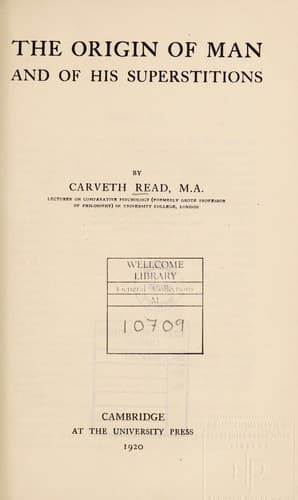
The Origin of Man and of His SuperstitionsRead, Carveth
Philosophy
The Origin of Man and of His Superstitions
Read, Carveth
Animism; Human beings -- Origin; Magic; Superstition; Totemism
In our modern analysis of mechanical causation there are four
requirements: (1) every event has a cause; (2) causation is uniform;
(3) the cause is the assemblage of the indispensable conditions of the
effect (and no others); (4) the cause is proportional to the effect. In
the savage’s mind these requirements are also obscurely recognised: (1)
he seeks a cause for everything: (2) he expects it to act uniformly:
(3) he believes in reinstating all the conditions of the effect, as
appears from his preparations for hunting, or war, or marriage, or
whatever he may have in hand; but he is much more ignorant than we are
as to what conditions are indispensable and decisive: (4) he knows
vaguely that the cause is proportional to the effect; for (_a_) he
succeeds in making effective weapons, etc., by mechanical means; (_b_)
he is very susceptible to the “size-weight illusion,” twice as much as
we are,[114] and this implies the adjustment of effort to a supposed
weight; (_c_) he repeats a spell in order to strengthen it, or unites
a talisman, a rite and a spell in one assault, implying that greater
force must be directed against greater resistance; and so on.
Causation, then, is universally assumed: how do Animism and Magic
influence the latent conception? As to Animism, (1) it palters with the
uniformity of causation; for though the ghost or spirit acts from human
motives, no one knows exactly what its motives are. It may be cajoled,
implored, even threatened; but the result does not always answer
desire: there is apparent caprice or free will, with consequent loss of
confidence, and an uncomfortable feeling that leads to a reaction in
favour of controlling the god, or ghost, by Magic. (2) The ghost is at
first merely a man-force disengaged from the visible body, but still
having its own body through which it can produce various effects. But
the fear of a ghost immediately endows it with superhuman power; and in
course of time it becomes more and more powerful, even to omnipotence;
so that it can of itself bring about any event; and, therefore, the
“assemblage of conditions” becomes unnecessary to causation: there
need be no visible conditions: miracles occur; creation out of nothing
is possible. (3) For such a power the “proportionality of cause and
effect” becomes almost meaningless; but not quite, for there are
degrees of spirit-force; and what one cannot do a stronger can.
Public-domain text, read in full here on John Shaqi.
Reviews
Reviews
No reviews yet
Be the first to share your thoughts on this work.
Elsewhere in the archive
Join the Discussion
Join the discussion
Sign in to leave a comment or review.
Sign InorCreate an account