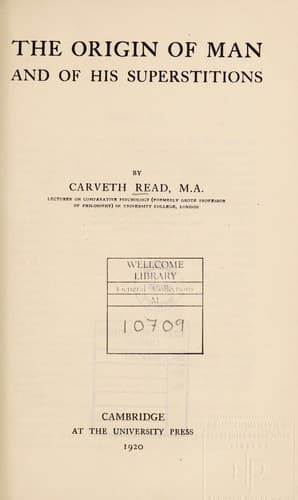
The Origin of Man and of His SuperstitionsRead, Carveth
Philosophy
The Origin of Man and of His Superstitions
Read, Carveth
Animism; Human beings -- Origin; Magic; Superstition; Totemism
The indirectness of a rite makes it more mysterious and magical, and
that is a recommendation. Moreover, its dramatic character gives
an imaginative satisfaction, which must suffice to initiate such
pantomime again and again. Amongst ourselves many people are prone to
dramatise every situation of their lives; to act in imagination their
loves, their revenges, their opportunities of self-display, and to
derive satisfaction from such imaginations even to the weakening of
their will—satisfaction without effort or danger. But although this
impulse may initiate pantomimic magic, it can hardly maintain it in
the absence of any deeper satisfaction. The belief in its efficacy,
again, once established, the effect of suggestion upon a victim of
black Magic (who by some means is acquainted with what has been done
against him) may have consequences that seem to verify the rites; but
this can only happen when a belief in the efficacy of such practices
already prevails. The power of suggestion depends upon the belief;
it cannot create the belief. We must fall back upon coincidence.
If, indeed, immediate and complete coincidence were requisite, if,
when one practised on an enemy’s life, nothing less than his speedy
death would do, coincidences might be too rare to give the requisite
confirmation. But if some less injury will be acceptable, and if it
need not follow immediately; if a delay of not merely two or three
days, but two or three months will bring the event within the limits
of satisfaction; and if the degree of injury may vary from death to
a bad fall, or some failure in hunting on the victim’s part, or a
quarrel with his wife; if even (as often happens) a misfortune to any
one of his family may suffice—the confirmatory coincidences will be
tolerably frequent. There must, of course, be many disappointments; but
these count for little, because the particular practice is supported
by a general belief in Magic; because men desire to believe and are
afraid to disbelieve; because failures are explained by some error in
performing the rites, or by the counteraction of superior Magic, or by
the intervention of hostile spirits.
Special reasons for practising and believing in indirect operations of
black Magic are their greater secrecy and, therefore, greater safety,
and greater gratification of the love of cunning: which last (I think)
explains much of the elaboration that marks these performances.
Public-domain text, read in full here on John Shaqi.
Reviews
Reviews
No reviews yet
Be the first to share your thoughts on this work.
Elsewhere in the archive
Join the Discussion
Join the discussion
Sign in to leave a comment or review.
Sign InorCreate an account