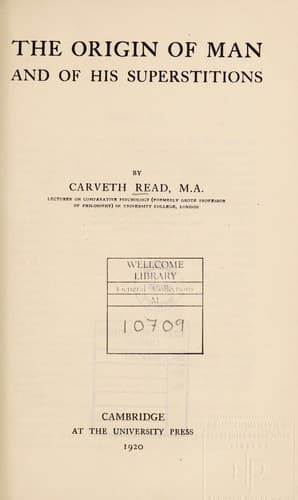
The Origin of Man and of His SuperstitionsRead, Carveth
Philosophy
The Origin of Man and of His Superstitions
Read, Carveth
Animism; Human beings -- Origin; Magic; Superstition; Totemism
Savages do not always regard a separable spirit as necessarily
belonging even to human nature. Dr. Seligman writes that, among the
Veddas, a few old men “were by no means confident that all men on their
death became _yaku_” (veridical ghosts). Influential men and mediums
would do so; but for the rest, at Godatalawa it was determined by
experiment. The ordinary man was invoked soon after death, and desired
to give good success in hunting; and if much game was then obtained,
he had become a _yaka_.[155] Messrs. Spencer and Gillen tell us that,
according to the Guanjis, a woman has no _moidna_ (spirit part).[156]
Major C. H. Stigand says “the Masai have no belief in a future state
for any but chiefs”; the common dead are not even buried, but merely
thrown out into the bush.[157] Among the Omaha, though each person has
a spirit that normally survives the body, still, a suicide ceases to
exist.[158] In Tonga the souls of the lowest rank of the people (Tooas)
died with their bodies.[159] The human spirit, then, is not necessarily
believed to enter upon a life after death; still less is the spirit of
an animal. On the other hand, it is held by many tribes that something
inherent in weapons, utensils, food and other objects, a “soul” or
soul-stuff, may be separable from them and go to Hades or serve as the
food of spirits, although the things themselves are not regarded as
having a spirit or intelligent life.
§ 2. PSYCHOLOGICAL ANIMISM
Andrew Lang described savages as existing in “a confused frame of
mind to which all things, animate and inanimate, ... seem on the
same level of life, passion and reason.”[160] Children and other
immature people are often supposed to be in the same condition. As
to children, it is pointed out how deeply concerned they are about
dolls and rocking-horses, how passionately they turn to strike a table
after knocking their heads against it. But probably it is now admitted
that impulsive retaliation, on a table or bramble or shirt-stud (not
unknown to civilised men), implies not any belief in the malignity
or sensitiveness of those objects. Animals behave in the same way.
Th. Roosevelt reports that an elephant was seen to destroy in rage a
thorn tree that had pricked its trunk;[161] and that in America he
himself saw a bear that was burying a carcass, and lost hold of it
and rolled over, strike it a savage whack, like a pettish child.[162]
Moreover, in children, such behaviour is in large measure due to
suggestion; inasmuch as the setting of them to beat the table, or what
not, is an easy way of diverting them from their own pain. And, of
course, the dealing with dolls, or rocking-horses, or walking-sticks,
as if alive, is play. Such play involves intense imaginative belief,
which, at first, is not clearly differentiated from earnest. But this
stage corresponds with the play of the young of the higher animals,
whilst they are still physically incapable of completing the preluded
Public-domain text, read in full here on John Shaqi.
Reviews
Reviews
No reviews yet
Be the first to share your thoughts on this work.
Elsewhere in the archive
Join the Discussion
Join the discussion
Sign in to leave a comment or review.
Sign InorCreate an account