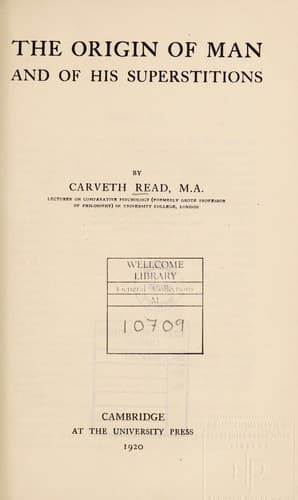
The Origin of Man and of His SuperstitionsRead, Carveth
Philosophy
The Origin of Man and of His Superstitions
Read, Carveth
Animism; Human beings -- Origin; Magic; Superstition; Totemism
To be clear about Animism, it is necessary to bear in mind several
modes of belief: (1) Hyperphysical Animism, that certain things
have, or are possessed by a conscious spirit, and that this spirit
is a separable entity; (2) that things are themselves conscious (or
semi-conscious), but their consciousness is not a separable entity;
(3) that things are not conscious, but are informed by a separable
essence, usually called soul (better, soul-stuff), which may be eaten
by spirits, or may go to ghost-land with them; (4) the extension or
limitation of these beliefs to more or fewer classes of things. Unless
these distinctions are recognised, any report upon savage beliefs can
hardly be clear and adequate; but generally we may take it that when
a traveller tells us that such and such things are not believed to
have souls, and says nothing of any belief as to their consciousness,
he means (except with regard to animals) to deny that anything like
human consciousness is attributed to them. And when Mr. Torday writes
that, according to the Bahuana of the Upper Congo, there are two
incorporeal parts—_doshi_, common to man, animals and fetiches, and
_bun_, peculiar to man—he seems to leave it as a matter of course
that plants and inanimate things have neither of these, and are not
conscious beings; though probably some of them have soul-stuff, since
clothes, weapons and food are buried with a corpse.[167] The Rev.
J. H. Weeks says that the Bakongo of the Lower Congo attribute a
spirit only to the _nkasa_ tree (from whose bark the ordeal poison is
derived) amongst plants;[168] and, similarly, the Baloki, further up
the river, attribute a spirit only to the _nka_ tree.[169] Since many
things are buried by these people in a grave, or broken above it, the
things may be supposed to have soul-stuff; but from the denying of
spirits to plants, and from silence as to psychological Animism, it
may be inferred that neither plants nor inanimate things are regarded
as conscious beings. Sir E. F. im Thurn tells us that material things
of all sorts are believed by the natives of Guiana to have each a body
and a spirit—evidently a conscious and malicious spirit; “and that
not all inanimate objects have this dual nature avowedly attributed to
them, is probably only due to the chance that ... the spirit has not
yet been noticed in some cases.”[170] Even with these Guiana Indians,
then, whose Animism, in every sense, is unusually active and extensive,
their attitude is an acquired, specialised way of imagining and dealing
with things that draw their attention and excite their suspicions, not
a primitive, necessary illusion; else there could be no exceptions.
Public-domain text, read in full here on John Shaqi.
Reviews
Reviews
No reviews yet
Be the first to share your thoughts on this work.
Elsewhere in the archive
Join the Discussion
Join the discussion
Sign in to leave a comment or review.
Sign InorCreate an account