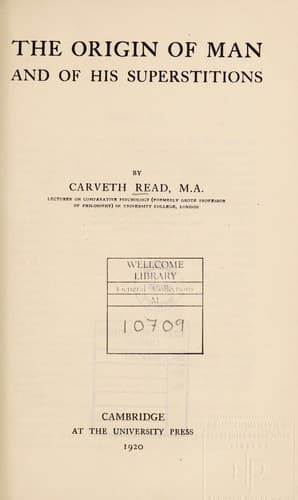
The Origin of Man and of His SuperstitionsRead, Carveth
Philosophy
The Origin of Man and of His Superstitions
Read, Carveth
Animism; Human beings -- Origin; Magic; Superstition; Totemism
A ghost is a disembodied soul, having a consciousness and power at, or
generally (because it is feared) above, the human level; but there may
be disembodied souls, or souls capable of disembodiment, that have no
consciousness, or none above the level of Animatism. Even if a living
thing have a consciousness, its post-mortem apparition may not; like
the Banks’ Islanders’ pig, which, though “a distinguished animal and
acknowledged to be intelligent,” has no true ghost. Among nearly all
tribes, whatever is offered in sacrifice to gods or left in, or at,
the tombs of men deceased, is believed to have some sort of soul;
because, plainly, spirits do not eat or consume the visible food or
utensils; yet it is necessary to the success of the rites to suppose
that the spirits are satisfied; they must, therefore, take the souls of
the offerings. And what can be more plausible reasoning than to argue
that, as solid men eat solid food, ghosts eat ghostly food? “Soul” thus
appears as a sort of ghost-substance, or ghost-body. For, in dreams,
the departed are seen as if in the flesh; and moreover analogy requires
that the ghost consciousness and ghost-force shall have a body of some
sort, and, of course, one that will maintain in ghost-land the same
relations to other things that the mortal body did in this world. In
ghost-land, or shadow-land, or dream-land, the substance of all things
is this soul-stuff. Sometimes the force of analogy requires a tribe to
believe that, in order that the souls of things (such as earthen pots
or weapons) may be released to accompany a ghost to the underworld,
the things themselves must be “killed,” that is to say, broken; but
other tribes are not such consistent logicians; and in some cases where
things left exposed at a grave (not buried) are broken, it may be to
prevent their being stolen.
Public-domain text, read in full here on John Shaqi.
Reviews
Reviews
No reviews yet
Be the first to share your thoughts on this work.
Elsewhere in the archive
Join the Discussion
Join the discussion
Sign in to leave a comment or review.
Sign InorCreate an account