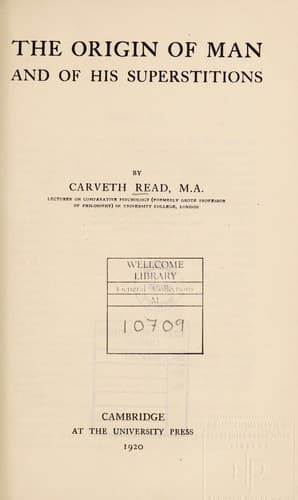
The Origin of Man and of His SuperstitionsRead, Carveth
Philosophy
The Origin of Man and of His Superstitions
Read, Carveth
Animism; Human beings -- Origin; Magic; Superstition; Totemism
Whilst of some tribes (for example the Indians of Guiana) it is said
that there is nothing to indicate that they “know of any spirits,
except such as are, or once were, situated in material bodies,”[198]
amongst others we are often told that not only ghosts are known but
also spirits that are declared never to have been incarnate. An extreme
form of the ghost-theory maintains that all spirits were once ghosts
whose incarnation has been forgotten; but this is needless, and seems
not to be true. It is enough that probably the original inhabitants of
the spirit-world were ghosts; that some of those now believed not to
have been ghosts were once really so; and that those spirits that were
never ghosts are later immigrants, who have obtained domicile by having
been imagined in analogy with ghosts. The following list indicates more
or less probable reasons why (_A_) ghosts have sometimes come to be
regarded as non-human spirits, and (_B_) why certain non-human things
have come to be regarded as spirits, or as possessed by spirits, more
or less resembling the human.
_A._ Spirits that were formerly ghosts, but are now declared not to
have been:
(_a_) Ghosts whose former life has been forgotten by mere lapse of
time. The memory of the dead amongst many tribes does not extend
beyond three or four generations. If then the ghost of some unusually
impressive personality happens to be remembered, when all his relatives
and contemporaries have been forgotten, he seems to be separated
from the human race. And if his name was that of some natural object,
his ghost, according to Spencer’s hypothesis, may now be regarded as
the spirit of that phenomenon. But as to Spencer’s hypothesis,[199]
although it gives such a plausible explanation of much nature-worship
by real facts as to the working of savage language and thought that it
seems to me unreasonable to doubt that it has had some of the effects
he traces to it, yet it presses upon me more and more that most cases
of nature-worship are to be explained by more particular causes.
Public-domain text, read in full here on John Shaqi.
Reviews
Reviews
No reviews yet
Be the first to share your thoughts on this work.
Elsewhere in the archive
Join the Discussion
Join the discussion
Sign in to leave a comment or review.
Sign InorCreate an account