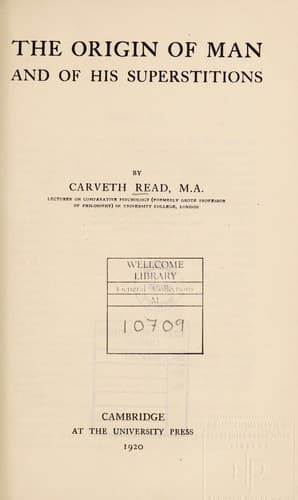
The Origin of Man and of His SuperstitionsRead, Carveth
Philosophy
The Origin of Man and of His Superstitions
Read, Carveth
Animism; Human beings -- Origin; Magic; Superstition; Totemism
In each of these cases, (_f_), (_g_), (_h_), however, an Euhemerist
explanation may be offered. As to (_f_), Spencer, of course, argued
that the Totem-ancestor is always a man, who bore the name of an
animal, and was confounded with it after death; and Dr. Rivers has
suggested that some gods who seem to have been derived from Totems may
really represent heroes who had such Totems.[204] As to (_g_), Grant
Allen suggested that the spirit of the corn or vine is always at first
the spirit of the man upon whose grave the plant grew.[205] And as
to (_h_), the spirit of a mountain may be the ghost of a man who was
buried on the top of it; and the spirit of a whirlpool the ghost of
a man who was drowned in it. Indeed some spirits may have originated
in one of these ways, others in another way; and what happened in any
particular case can only be determined, if at all, by examination of
its particular circumstances.
(_i_) Abstract ideas may, at a very early stage of culture, be
personified and treated as spirits. The Semang, according to Messrs.
Skeat and Blagden, personify Death, Hunger, Disease;[206] and the
Beloki, according to the Rev. J. H. Weeks, attribute all personal
qualities to the aid of spirits; so that if one man wrestles better
than another, it is because the spirit Embanda is in him.[207] The
modern Greeks of Macedonia personify and propitiate Lady Small
Pox.[208] In the tenth and latest book of the _Rigveda_, “the
deification of purely abstract ideas, such as Wrath and Faith, appears
for the first time.”[209] At a higher stage of culture we find Fides,
Fortuna, Concordia and many others. Such things are conceived of as
mysterious powers, and they have names; and so far they resemble
demons. Why, then, should they not be personified and propitiated like
demons?
(_j_) Various ways have been pointed out in which the grammatical
structures of language, metaphors and other figures of speech may
influence the growth of mythology.
(_k_) Animism having been generally adopted, spirits may be freely
invented in explanatory myths. The Kalinis believe that thunder
and lightning are the clang and flash of bracelets on the arms of
Kidilumai, a girl who dances in heaven, as formerly on earth, for joy
of the welcome rain.[210] It would be absurd to suppose that she must
once have lived on earth. Some amongst the Ekoi say that Thunder is a
giant marching across the sky; others that Thunder is the enemy of
Lightning and, on seeing it, growls to drive it away.[211] If free
invention may originate myths, it may modify old ones, with results
that cannot always be interpreted upon general principles.
Finally, any spirits that have been anthropomorphised in analogy with
ancestor-ghosts may be further disguised by giving them mythical family
connections with the ancestors and with one another, as happened to
Bacchus and Demeter.
§ 7. HOW GHOSTS AND SPIRITS ARE IMAGINED
Public-domain text, read in full here on John Shaqi.
Reviews
Reviews
No reviews yet
Be the first to share your thoughts on this work.
Elsewhere in the archive
Join the Discussion
Join the discussion
Sign in to leave a comment or review.
Sign InorCreate an account