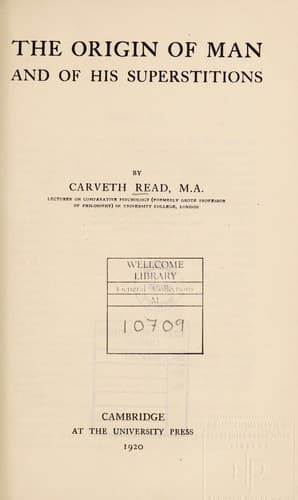
The Origin of Man and of His SuperstitionsRead, Carveth
Philosophy
The Origin of Man and of His Superstitions
Read, Carveth
Animism; Human beings -- Origin; Magic; Superstition; Totemism
The matter presents itself to me in this way: at first, belief in Magic
arises as a means of obtaining good and averting evil. Grounded, as Sir
E. B. Tylor says,[274] in the desire “to discover, to foretell, and to
cause events,” it is irresistibly attractive by its power of increasing
one’s confidence, of making sure.
Secondly, at some stage after the rise of Animism, religious practices
are added to the magical, to make assurance doubly sure, just as one
magical practice may be added to another, a rite to a spell. At this
stage, there is no sense of opposition between Magic and Religion.
That, in fact, they are opposed in their nature, as an invariable
to a capricious force, even if this difference were appreciated by
savages, need not prevent their co-operation; for Magic is known to
be a tendency that may fail of the effect desired, either by the
counteraction of superior Magic, or by imperfection in the rites; and
one sees no reason why a spirit should not be supplicated to supplement
the imperfect rites, or to frustrate the superior Magic. To supplicate
the intervention of spirits, once they are fully believed in, is an
act so simple and natural, that we may wonder how it should ever be
omitted where Animism prevails. For what can be more spontaneous
than to ask the aid of one’s father or friend, and why not ask the
spirits disembodied as freely as those in the flesh? In Melanesia not
every ghost is worshipped (as not having _mana_); but a man in danger
may call upon his father, grandfather or uncle: his nearness of kin
being sufficient ground for it.[275] Certainly: and that this is not
always done where ghosts are rife can only be because it is believed
that the less one has to do with them the better! Probably, this
consideration restrains for ages the early impulses to pray. Primitive
man anticipates the advice of Confucius: “Pay all respect to spiritual
beings, but keep them at a distance.”[276]
Thirdly, certain forms of Magic come, after a time, to be
discountenanced or punished: black Magic, because it is anti-social
and criminal; other forms of Magic, when carried on by private
practitioners, because they infringe the monopoly of supernatural
power that has now been claimed by dynasties and priesthoods; or (in
other words) because the public gods are jealous of all competitors.
Legitimate Magic has now been incorporated with Religion. And the
power of Religion becomes greater than that of Magic without Religion,
not only by the support of the influential classes, but also because
Religion, whether as worship of the public gods or as sorcery or
devil-worship, afflicts the human mind with peculiar terrors; and,
again, because Religion, should it clarify morally and æsthetically,
appeals more and more to the affections—to the family affections
and to loyalty. The impersonality of pure Magic sets it (as it does
Science) at a great disadvantage in this competition.
Public-domain text, read in full here on John Shaqi.
Reviews
Reviews
No reviews yet
Be the first to share your thoughts on this work.
Elsewhere in the archive
Join the Discussion
Join the discussion
Sign in to leave a comment or review.
Sign InorCreate an account