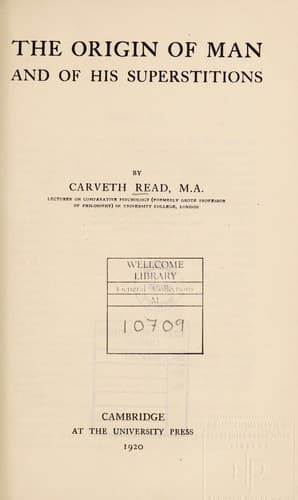
The Origin of Man and of His SuperstitionsRead, Carveth
Philosophy
The Origin of Man and of His Superstitions
Read, Carveth
Animism; Human beings -- Origin; Magic; Superstition; Totemism
(_a_) Fundamental in Magic, wherever practised, is the idea of force,
invisible and intangible, which can operate at a distance without any
visible or tangible vehicle. The idea may have been formed (as we have
seen) by analogy with several natural phenomena, such as the wind,
radiant heat, sound, odour, and it is involved in a savage’s beliefs
concerning the efficacy of charms, rites and spells. When a man dies,
he lies speechless and motionless, no longer exerts his accustomed
force in any way; but, if seen in a dream, he still speaks and acts,
perhaps wrestles with the dreamer. Here, then, is that force which
had deserted the body: it is visible and tangible in dreams only, or
perhaps sometimes by twilight; or to gifted seers, or to dogs or pigs.
The force exerted by the ghost or spirit is the same thing as force
magical, except in one character: its action is capricious, depending
on the good or ill will of the ghost or spirit; whereas purely magical
forces have uniform tendencies. Magic, then, prepares and partially
develops this idea of mysterious force, without which the appearance of
a dead man in a dream, after his body has been buried or burnt, would
have no reality or practical consequences for the living. Comparison
with shadows and reflections could not lend reality to dreams; for they
require the presence of the body, and themselves have no mechanical
significance. Their association with the spirit or ghost probably
follows the use of their names to describe the dream-imagery, which
cannot at first have a name of its own. The same names being used for
shadow or reflection and for spirit or dream-soul, the things are in
some measure identified; and then the idea of force may be associated
with shadows and reflections; so that the falling of a shadow upon a
man may injure or slay him.
Magic-force and spirit-force being the same thing, the question whether
_mana_ is a magical or animistic notion is misleading. It will be
conceived of by different tribes in one way or the other, according to
the relative prevalence in one or the other tribe of the animistic or
of the magical mode of explanation.
(_b_) It is reasonable to expect that, as the ghost-theory spread, the
magical force of things should sometimes be conceived of as spiritual;
so that amulets and talismans would come to be regarded as owing their
virtue either to a controlling spirit, or to an indwelling spirit
peculiar to each: in the latter case the charm is a fetich. When a
charm is thus considered, its efficacy is no longer expected to be
uniform, but depends on the mood of the indwelling or controlling
spirit. The fact that its efficacy, though formerly presumed to be
uniform, never was so, favours the new interpretation; and this having
been accepted, a cult (or a discipline) of the spirit is apt to follow.
Thus the magician becomes a sorcerer or a priest.
Public-domain text, read in full here on John Shaqi.
Reviews
Reviews
No reviews yet
Be the first to share your thoughts on this work.
Elsewhere in the archive
Join the Discussion
Join the discussion
Sign in to leave a comment or review.
Sign InorCreate an account