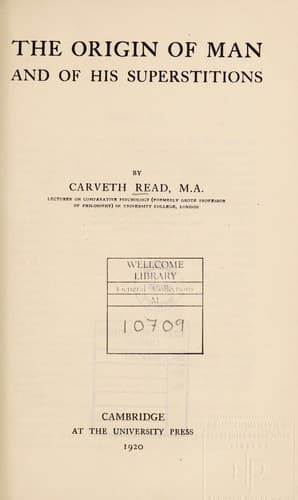
The Origin of Man and of His SuperstitionsRead, Carveth
Philosophy
The Origin of Man and of His Superstitions
Read, Carveth
Animism; Human beings -- Origin; Magic; Superstition; Totemism
Not only the spirits of primitive Animism, but likewise the gods of
maturer Religions, know and teach Magic. In the Maori mythology,
Tumatauenga, one of the first generation of gods, determined
incantations for making all sorts of food abundant and for controlling
the winds, as well as prayers to Heaven suited to all the circumstances
of human life; and the god Rongotakawin, having shaped the hero
Whakatau out of the apron of Apakura, taught him Magic and enchantments
of every kind.[303] Prof. Rhys tells us that the Welsh god Mâth ab
Mathonwy, or Math Hên (the ancient), was the first of the three great
magicians of Welsh Mythology; and he taught Magic to the culture
hero, Gwydion ab Dôn, with whose help he created a woman out of
flowers.[304] The Teutonic equivalent of Gwydion is Woden, or Othin;
and he too was a magician, “the father of spells,” who acquired his
wisdom by gazing down into the abyss, whilst he hung nine nights on
the tree, an offering to himself (and in other ways); and, in turn, he
teaches Siegfried the omens.[305] He also taught the northern people
shape-changing, and by spells controlled fire and the winds.[306] In
Egypt Magic was taught by Thoth, in Babylonia by Merodach, and in Japan
by Ohonomachi the earth-god. Indeed, whence, unless from divine beings,
could this precious wisdom be obtainable?
Spirits also inspire or possess the magician, so that through him,
as their mouthpiece or instrument, prophecies are uttered or wonders
wrought. We have seen that in South-East Australia the rites of
initiation to wizardry by a wizard, without the aid of spirits, cause a
candidate to become frenzied or maniacal. With the growing fashion of
animistic interpretation, such behaviour is (along with insanity) put
down to possession by a spirit. The common beliefs that a man’s soul
can slip in and out of him and that a man may reincarnate the spirit
of an ancestor, facilitate this idea of possession. Dreams concerning
spirits also promote the belief that a miracle-monger owes to them
his supernatural powers. The Tunguses of Turnkhausk say that the man
destined to be a shaman sees in a dream the devil performing rites, and
so learns the secrets of his craft. Among the Trans-Baikal Tunguses,
he who wishes to become a shaman declares that such or such a dead
shaman appeared to him in a dream, and ordered him to be his successor;
and he shows himself crazy, stupefied and timorous. The Yakut shaman
is preordained to serve the spirits, whether he wishes it or not: he
begins by raging like a madman, gabbles, falls unconscious, runs about
the woods, into fire and water, injures himself with weapons. Then an
old shaman trains him.[307] On the Congo, a man may become a wizard
by claiming to be the medium of a dead man; and a medium falls into a
frenzy, shouts, trembles all over, his body undulates, sweat breaks
out, foam gathers on his mouth, his eyeballs roll: he speaks an archaic
Public-domain text, read in full here on John Shaqi.
Reviews
Reviews
No reviews yet
Be the first to share your thoughts on this work.
Elsewhere in the archive
Join the Discussion
Join the discussion
Sign in to leave a comment or review.
Sign InorCreate an account