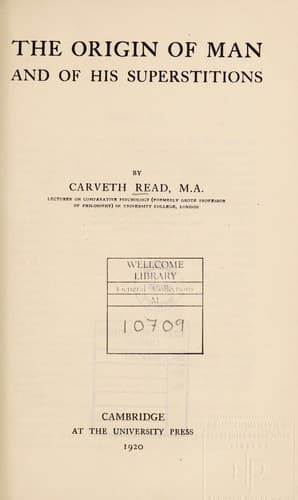
The Origin of Man and of His SuperstitionsRead, Carveth
Philosophy
The Origin of Man and of His Superstitions
Read, Carveth
Animism; Human beings -- Origin; Magic; Superstition; Totemism
Another way of excluding spiritual caprice, which we might suppose to
have been discovered by philosophers, but which appears to be older
than what we usually call “Philosophy,” is to subordinate the gods to
Fate. The idea has been attributed to the astronomers or astrologers
of Babylon that Fate must be above the gods as the constant heaven of
the fixed stars is above the planets:[338] an analogy characteristic
of magical thought. But the roots of the idea of Fate are much
older and wider spread in the slow, steady growth of the belief in
uniformity, which is the common ground of Magic and Science; and (as
I have said) before laws of nature had been discovered, Fate was an
all-comprehensive Magic. Fate reduces the gods to the status of wheels
in a machine; omens and oracles, instead of being sent or inspired
by the gods, are also part of the machinery, and may point to their
destruction; prayers and sacrifices are other parts of the machinery
and, at most, may be a means of assuaging the anxiety of one’s own
heart. A stern way of envisaging the world: but it gives not only
security against the gods, but also resignation and tranquillity.
Philosophical Christianity regards the actions of God as always
manifested, in the physical order, through “second causes,” or, in
other words, in “the laws of nature”; and, in the spiritual order,
as always observing the moral laws that are the principles of divine
Reason; in either case there can be no variableness nor shadow of
turning.
Public-domain text, read in full here on John Shaqi.
Reviews
Reviews
No reviews yet
Be the first to share your thoughts on this work.
Elsewhere in the archive
Join the Discussion
Join the discussion
Sign in to leave a comment or review.
Sign InorCreate an account