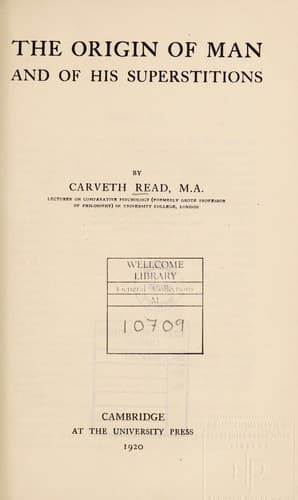
The Origin of Man and of His SuperstitionsRead, Carveth
Philosophy
The Origin of Man and of His Superstitions
Read, Carveth
Animism; Human beings -- Origin; Magic; Superstition; Totemism
Belief in Omens and the practice of observing them having been
established, the list of portentous events grows ever larger. (_a_) In
a depressed frame of mind the future looks gloomy; in exhilaration,
cheerful. A sensation, such as shivering, or sweating, that accompanies
fear is apt to excite fear. In fear or depression one acts feebly
and fails; in hope and confidence one acts vigorously and wins: the
expectations produced by such moods fulfil themselves, and therefore
the moods are ominous. This may be the reason why, when men are at
strife and some ambiguous Omen occurs, he who first claims its favour
or denounces its menace upon his enemy, gains an advantage;[345] for
the other may be daunted and unable to rally his forces. But that
depends on character.
This subjective value of an Omen, making its virtue a function of the
recipient’s disposition, sometimes became so prominent as to obscure
its truly magical character; according to which it must be indissolubly
connected in some way with the event and can have nothing to do with
the recipient’s attitude. Thus it might be held that an Omen, if it
deeply affected a man’s imagination, would be fulfilled; but, if
neglected, it might not be. Pliny says[346] that, according to the
augurs, auspices had no import for one who in any enterprise declared
that he would not regard them. Or, again, the bearing of an Omen may be
determined by the way in which it is accepted: Julius Cæsar, landing in
Africa, fell; and that must have seemed a very bad Omen; but he, having
the presence of mind (though not exempt from superstition) to exclaim:
“Africa, I lay hold of thee!” changed its significance;[347] and,
doubtless, greatly altered its effect upon the minds of his officers
and soldiers and of all who heard of it; and that was the important
matter. Hope and desire and anxiety created Omens, and they had also
the power to direct the incidence and corrupt the interpretation of
Omens. In fact, there were conventional formulæ for accepting good
Omens and rejecting bad ones: _Accipio omen, Absit omen, Tibi in caput
redeat;_ which were counteractive spells; and it is agreed that Magic
may be overcome by stronger Magic.
Public-domain text, read in full here on John Shaqi.
Reviews
Reviews
No reviews yet
Be the first to share your thoughts on this work.
Elsewhere in the archive
Join the Discussion
Join the discussion
Sign in to leave a comment or review.
Sign InorCreate an account